


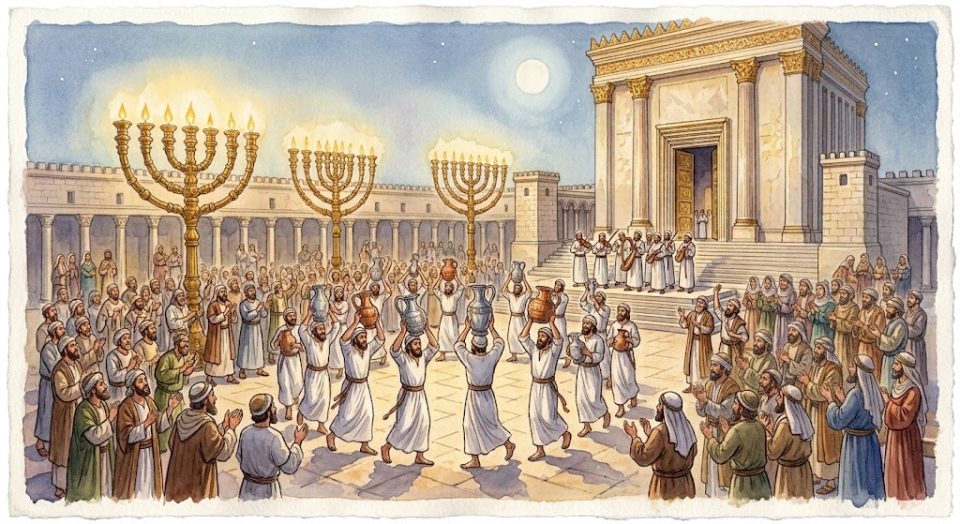
The universal ushpiz (spiritual guest) of Klal Yisrael today (fifth day of Sukkot), according to the order of the sefirot, is Aharon . It is written that the entire Sukkot in essence is connected to Aharon, because all of Sukkot is a remembrance of the Clouds of Glory God placed over and around us during our years in the wilderness. We must remember this from the very first mitzvah of the festival, on the first day—“so that your generations may know that I made the Children of Israel dwell in sukkot,” etc. The sukkot we sit in are the Clouds of Glory, in the merit of Aharon, and we must remember him from the very first moment the festival begins—the entire festival is in his merit. Sukkah is also a term related to “Yiskah,” a term for “seeing”—through Ru’ach HaKodesh (Divine Spirit); that is why at Simchat Beit HaSho’eivah people would merit receiving Ru’ach HaKodesh—“you shall draw water joyously from the wellsprings of salvation.” The libations of the rest of the year are all of wine and therefore they correspond to our sense of hearing (for wine relates to the sefirah of understanding, and understanding corresponds to our sense of hearing, “I have heard, God, of Your renown, and I was in awe”), but on Sukkot we bring a special water libation. Water corresponds to wisdom, which is sight—that is why on this festival we see Godliness. All year long we can only have second-hand (hearsay, in a sense) knowledge of God’s essence, but ion Sukkot we can potentially grasp the essence directly (akin to seeing it). This too pertains to Aharon, who s commanded to kindle, which in Hebrew is “to raise” the flames in the Temple Menorah, each of which corresponds to one of the soul roots of the Jewish people. Today we would say that Aharon lights up whatever room he enters. When all the souls in a room are illuminated, one can see God’s essence. As the Ba’al Shem Tov said, add light to the room. When there is light, one sees the “visage of the Cohen” (מַרְאֵה כֹּהֵן), a term whose value is identical to “Divine Providence” (הַשְׁגָּחָה).
First, this means seeing individual Providence in every aspect of reality. One sees more and more Providence. The analogy for this is that just as adding a penny (perutah in Hebrew, which also means “a detail”) to a penny produces a large sum in the end, so we must start by collecting the Divine Providence we see in each detail of life and in each individual soul, until we discover the essential underlying Providence with which God governs all. This is the foundational directive given by Rebbe Nachman and by all other tzaddikim. When I see the individualized Providence in every detail, in the life of every soul, that still doesn’t mean I perceive Godliness with my sense, but it adds up to a great sum.
The final result is that one sees actual Godliness, but for that one needs many pennies, many particulars, many small instances of Providence. Of every small instance of Providence it is written that “every single penny adds up to a great sum.” Until now I have heard—“I have heard of Your renown”—I have heard that there is the Holy blessed One who performs miracles, but one must see it with one’s own eyes; it is not enough to hear. The joy in “the time of our rejoicing” comes from the fact that at long last I merit to see God now, on the festival of Sukkot. As we said, this is especially connected to Aharon (אַהֲרֹן) the letters of whose name spell “is seen” (נִרְאֶה) alluding to the verse, “for with You is the source of life; in Your light do we see light,” “for You, Lord, are seen.” May we merit to see Godliness with our senses. Indeed, the Sages connect joy and sight in their statement amount Sukkot: “Whomever did not see Simchat Beit HaSho’eivah never saw joy in his life”—one must see joy.
In Kabbalistic nomenclature, joy is the inner experience of Imma, the mother principle that is the mature sefirah of understanding. To see the joy is to unite the Abba, the father principle and the sefirah of wisdom with Imma.

