


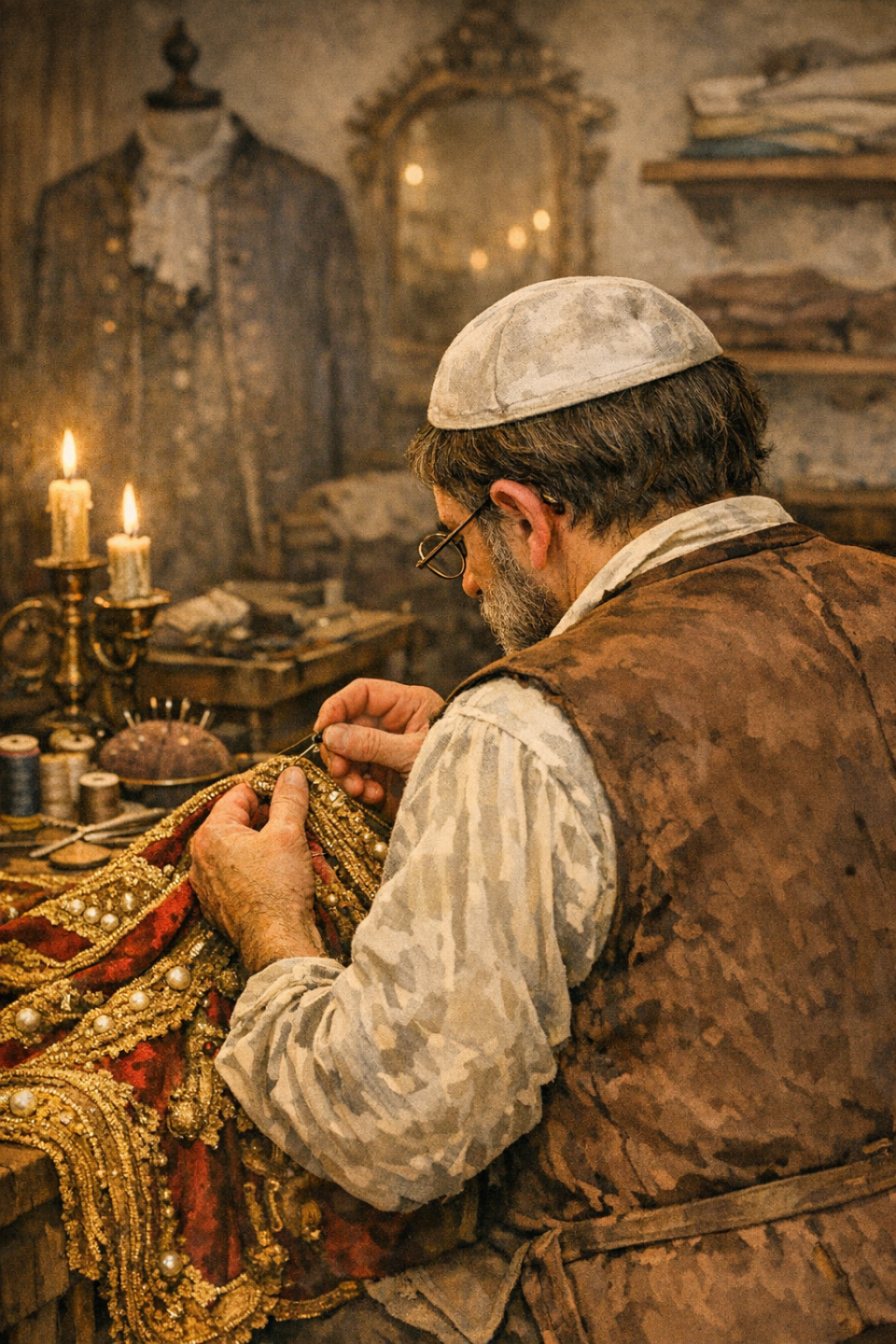
Rabbi Yerachmiel Rabinowitz of Peshischa was born in 5544 (1784) to his father Rabbi Yaakov Yitzchak, the Holy Jew of Peshischa. He was a disciple of his father and of the Holy Grandfather of Radoshitz. He married the daughter of Rabbi David Dov, Chief Rabbi of Sadeh Lavan in Russia, son-in-law of Rabbi Yehoshua Yechezkel Feivel Frankel-Te'omim of Ostrowiec. During his father's lifetime, Rabbi Yerachmiel earned his livelihood from the watch trade and their repair. After the passing of his father, "the Holy Jew," leadership of the community passed to his primary disciple, Rabbi Simcha Bunim of Peshischa, while Rabbi Yerachmiel began leading a Chasidic court in Peshischa only fourteen years after his father's death. Rabbi Yerachmiel's leadership was more moderate than his father's and closer in character to other Chasidic courts in Poland. His Torah teachings combine brief and sharp sayings in his father's manner with Chasidic folkways from the study hall of the Seer of Lublin. He passed away on the 8th of Iyar 5596 (1836) and rests in honor in Peshischa.
There was a tailor in the vicinity of Peshischa who was held in high regard by the nobles. Once, a certain nobleman bought fabric in Paris for a garment, called the tailor and said to him: "This fabric is very expensive, therefore make sure that the garment will be stunning, worthy of such fabric." The tailor laughed and said, "Why does my lord say such a thing? Am I not the most expert tailor!" The nobleman gave him the fabric, and he made the garment. But when the nobleman tried it on, he and his people began shouting at the tailor that he had ruined the garment. They drove him away in great anger from the courtyard and threw the garment after him as well…
Ultimately, the tailor became destitute. His wife said to him: "Everyone goes to the tzaddik Rabbi Yerachmiel, son of 'the Holy Jew' of Peshischa. Listen to me and go to him as well!" The tailor came to Rabbi Yerachmiel and told him the entire story. The tzaddik replied:
"Undo all the seams of the garment, sew it again with the very same stitches, and bring it to the nobleman." The tailor laughed inwardly at this advice, but he had no other choice, so he followed Rabbi Yerachmiel’s instructions. When he brought the garment again to the nobleman, the nobleman called his wife to see it as well, and it pleased them greatly. They appeased the tailor and added to his wages.
When the tailor came to Rabbi Yerachmiel and told him what had happened, the tzaddik said to him:
"I recognized in you that the first time you made the garment with pride and arrogance – and pride has no grace, therefore it did not please them. But when you came to me, I saw that you were in a state of lowliness and submission, therefore I told you to undo the stitches of pride and sew it anew with humility, and it would have grace."
Can a garment possess inner beauty?
The beauty of garments, and generally beauty that is expressed outwardly, is sometimes perceived as external and crude: "Grace is false and beauty is vain." But Rabbi Yerachmiel teaches that soulful beauty is certainly capable of radiating outward – and even influencing the charm of a garment in the eyes of the beholder.
Of course, since we are dealing here with divine service and not tailoring, the question that concerns us is different: if true beauty is spiritual and inner even in material things like a garment, then certainly in spiritual matters there is importance to beauty. Indeed, one could even say that all divine service stems from our desire to adorn ourselves before Him, and to find favor in His blessed eyes. What then is beautiful in God's eyes?
"A sheiner yid [beautiful Jew]" – who is that?
One might think that the most beautiful is a perfect tzaddik – one who has never sinned and will never sin, like the common expression "a sheiner yid " about a Jew who appears complete in his religious observance. But in truth, real charm lies in the humility of the ba’al teshuvah (penitent), who yearns to draw ever closer to the King. Even the true tzaddikim, with all their perfection, always lived with the feeling of "all his days in teshuvah" and constant advancement – one that sees yesterday's mitzvot and service as lacking and flawed compared to today. Of this it is said, "Better is one hour of teshuvah and good deeds in this world than all the life of the World to Come."
If we survey the soul's powers according to Chasidut, we see that the force motivating teshuvah is specifically lowliness – which according to Rabbi Yerachmiel can grant charm even to a garment. Therefore, the superiority of baalei teshuvah over tzaddikim teaches us the source of true charm: in contrast to the "false grace" of perfection and self-confidence, true grace flows from the feeling of distance and the desire to draw close. This is also reflected in parallel verses in Proverbs: "The lowly in spirit will support honor," and "A woman of grace will support honor." The lowly in spirit, the baal teshuvah, is the "woman of grace" of the Holy One, filled with inner beauty (and by way of allusion – the first letters of baal teshuvah has the initials bat [daughter], while in contrast the tzaddik is a son). It should be noted that the woman's connection to this service is not specifically through self-abasement: she has sufficient lowliness of her own, flowing in her blood naturally. Specifically, the man needs to receive the portion of lowliness from his wife, so that he too will be full of grace like her.
And behold, "beauty" (yofi) in the numerical system atbash equals "blemish" (mum) – a most wondrous allusion, the secret of "You are altogether beautiful, my beloved, and there is no blemish in you." When a person feels blemished, broken and distant, then he merits "there is no blemish in you": he feels the nothingness within himself, the nothingness of lowliness and longing for closeness to God. Thus, he merits to do teshuvah, and to find grace in the eyes of God and man.

