


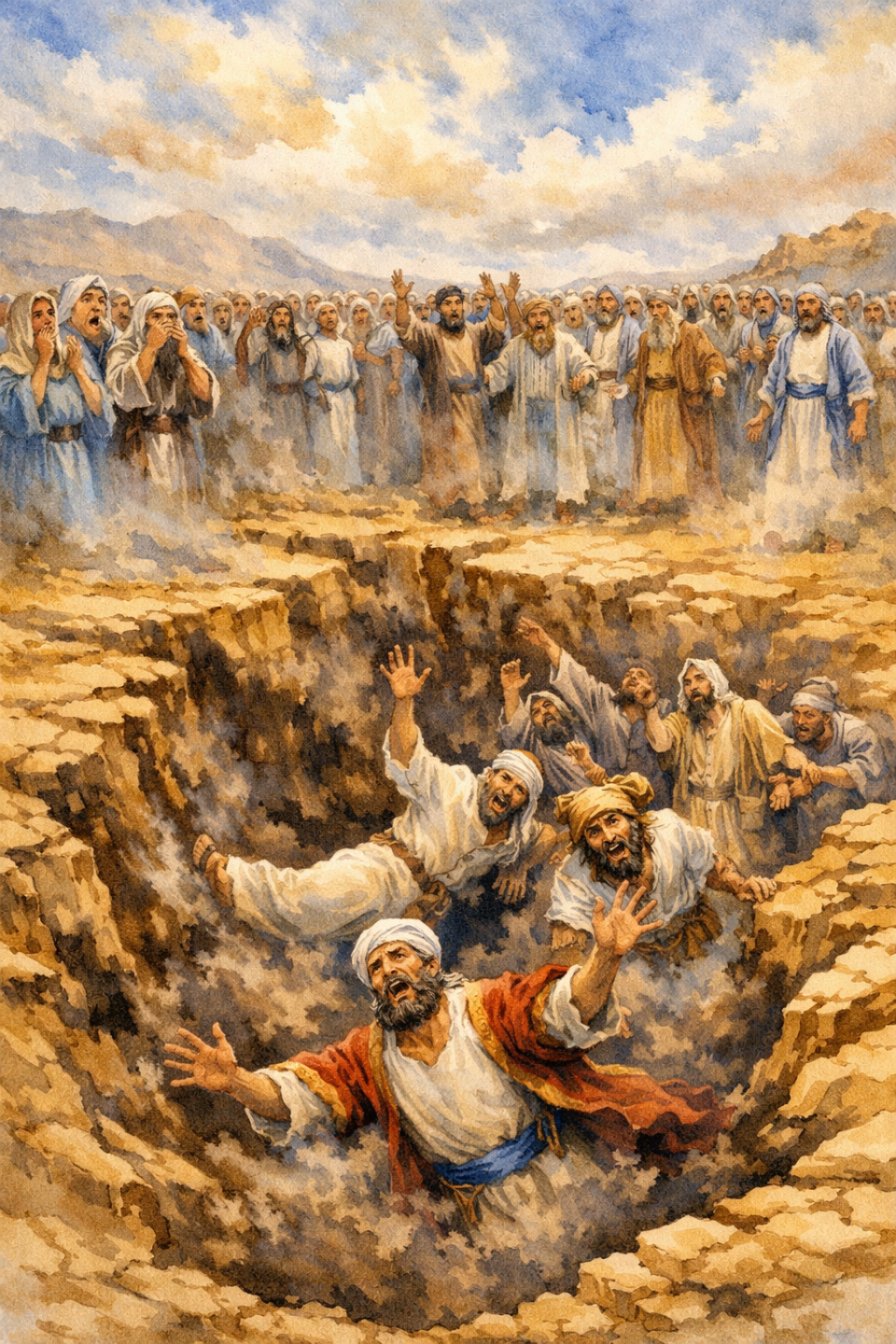
In parashat Korach, Korach organizes a rebellion against Moses’ leadership, and the principle of “measure for measure” is evident on both conceptual and practical levels. The Arizal teaches that Korach’s soul belongs to the soul root of Cain Adam’s firstborn son, and Moses’ soul belongs to the soul root of Abel, whom Cain murdered.[1] The spiritual line of Moses’ previous incarnations are hinted to in his name (מֹשֶׁה) whose three letters are the initials of Moses, Seth, and Abel (מֹשֶׁה שֵׁת הֶבֶל).[2]
There are many obvious similarities between Cain and Abel and Korach and Moses. Just as Cain was jealous of Abel because God chose his offering, Korach was jealous of Moses (and Aaron) because God appointed them as leaders, but he was not. Furthermore, after God chose Abel’s offering, He tried to comfort Cain by teaching him to fight his tendency for jealousy and depression, so that he would increase his satisfaction with his lot in life.[3] Likewise, Moses attempted to calm Korach down by providing him with reasons to be content with his life circumstances. Both attempts failed.[4] Cain pursued Abel and killed him and Korach pursued his rebellion until the bitter end.
The principle of “measure for measure” plays itself out when the earth, which had “opened its mouth” to cover up Cain’s crime,[5] opens and swallows up Korach and his followers, as the verse recounts, “and the earth opened its mouth and swallowed them.”[6] Likewise, the very image of the earth opening its mouth suggests that both Cain and Korach were tripped up by the words that came out of their own mouths. In recounting Cain’s murder of Abel, the Torah states the following: “Cain spoke with his brother Abel. And it happened when they were in the field that Cain rose up against his brother and killed him.”[7] While the text does not reveal what Cain said to his brother, presumably, it was these words that led to Abel’s murder. In Korach’s case, the opening phrase of the portion, “and Korach took,”[8] lacks a direct object; what did Korach take? Therefore, the Sages explain that here the verb “to take” means to “ensnare.” Korach ensnared the peoples’ hearts, tricking them by cloaking his own anger and ambition in populist rhetoric aimed at enlisting their support.
A Disagreement Not for the Sake of Heaven
It states in Pirkei Avot:
Any disagreement that is for the sake of Heaven will endure, but any disagreement not for the sake of Heaven will not endure. What is a dispute for the sake of Heaven? The arguments between Hillel and Shammai. What is a dispute that was not for the sake of Heaven? The argument of Korach and his company [against Moses].[9]
Korach’s argument that all members of the Jewish people are holy and that God is among them was a very strong and persuasive argument for it is undeniably true.[10] His downfall though was that he turned a profound truth into a populist platitude for the sake of advancing his personal agenda. It can even be said that his populism foreshadowed democracy far before that concept was conceived in Athens around a thousand years later.[11]
Chasidut teaches that although the notion that all Jewish people are holy and God is among them is certainly true, the full manifestation and revelation of this truth will only truly occur in the future. Until then hierarchy is both a natural and necessary component of human relations. Korach was arguing that the future, in a sense, had already come; therefore, there was no need for a leader like Moses whose authority exceeded everybody else’s. Ironically, Korach, the populist libertarian, cynically employed the notion of equality to advance his own ambitions, while Moses, described by the Torah as the humblest man on the face of the earth,[12] appears to be selfishly fighting to maintain his authority. However, there is no doubt that Moses never sought power and authority for himself; clearly, he only fought Korach’s bid for power because he had no doubt that God had appointed him to lead His people.
Right and Left
In contemporary politics, the label “right” and “left” are common. Despite the tendency to think that these are modern labels to depict different political philosophies, the idea of right and left is intrinsic to fundamental concepts of Kabbalah.[13] The ten sefirot are based on archetypal energies depicted structurally by right and left axes, as well as an integrative middle axis. The Zohar identifies Moses with the energies of the right side, especially loving-kindness, while Korach is identified with the left side, especially the aspect of might.[14] Likewise, Abel represents the right side and Cain the left side.
Moses’ love of the people and his constant willingness to sacrifice his own needs for others and defend the people before God was exhibited repeatedly in his life. Korach on the other hand exhibited a thirst for power and might, as he rebelled against Moses and his authority, wanting to take all the power in his own hands, causing deep division and a lack of compromise.
Yet, we see in this story how Moses, after initially humbling himself and begging Korach and his followers to stand down, adopts a very strong stance and exhibits his own brand of might in defending his role as leader, a trait seemingly opposite to his usual “right-side” nature. Paradoxically Korach presented himself as a man of loving-kindness, a lover of the people, and one who has their interests in mind and would bring them true equality.[15] To understand this seeming switching of roles we turn to a number of important concepts in Kabbalah and Chasidut.
Three Types of Intellectual Thought
A deep type of intelligence referred to as “inter-inclusion” posits a type of understanding of reality that goes beyond the superficial appearance of things. Through inter-inclusion, one can gain the ability to perceive how one thing is included or manifest in something else. This is the way the sages of the Talmud describe the faculty of understanding (binah): to comprehend one matter within or from another.[16] This way of thinking is prevalent throughout Jewish tradition, especially in the in-depth learning found in the Talmud.
Another concept that relates to our discussion is “trading places” (achlifu duchtayu), a term that is used when a sage who usually adopts a certain consistent stance in Jewish law, in an exceptional case, takes a (seemingly) opposite stance.[17] A third concept that is relevant is called “the opposite is the case” (ipcha meestabra). This term is used when, in a Talmudic discussion, an opinion or conclusion is presented that is the opposite of what one might initially (logically) think.
It is certainly interesting to note that it is now known that the right brain controls the left side of the body while the left side of the brain controls the right side of the body.[18] In a similar but slightly different manner, the retina transmits images to the brain upside down and then the brain flips them right side up. These two physiological realities are hinted to in the Hebrew word sikel (שִׂכֵּל), employed to describe how Jacob crossed his hands when he blessed his grandson's Ephraim and Menasseh.[19] The word sikel comes from the same root as sechel (שֵׂכֶל), meaning intelligence.
In our case of Moses and Korach, we see that is exactly what occurred, each one adopting an opposite personality trait fitting for the call of the hour.[20] Yet we see in the three ideas just presented—inter-inclusion, trading places, and the opposite is true—seeds of a solution for the binary, dualistic world we live in. Similar to how the middle axis of the sefirot is one of integration, holism, and harmony, people in all areas of life need to find ways to integrate opposing opinions. This is particularly relevant to healing the deep discord found in politics everywhere. Yet, it is not confined to just that realm but is appropriate in myriad situations and relationships in life. We are not speaking of abandoning one’s beliefs for others but rather of an openness to see points of truth in other opinions and the willingness to bring together various good points in order to create peace and build better working models of cooperation instead of automatically discarding any but our own opinions.[21]
One Step Deeper
It is fascinating to note that on a deep superconscious level both Moses and Korach actually had sparks of their opposite—Moses has a part of Cain and Korach has a part of Abel. According to the Arizal, all souls can be traced primordially back to Adam, Cain and Abel. Korach felt he also had a part of Abel within him as only by incorporating both these energies could he bring all Israel behind him in his rebellion. As for Moses (מֹשֶׁה), his name equals 345 and when subtracting 37, the gematria of Abel (הֶבֶל), 308 remains, which is the value of Korach (קֹרַח)! Due to Moses’ elevated soul, he was able to rectify the sparks of Cain and Korach in his soul, whereas Korach had yet to accomplish that sort of rectification. This is alluded to in the opening verse where it is stated that “And Korah took,” he took only the negativity of Cain which overwhelmed the good sparks of Abel he had in potential.[22]
Into the Future
Although the classic case provided by Pirkei Avot to illustrate an argument not for the sake of Heaven is that of Korach, the Arizal revealed that even in this disagreement both disputants possessed an element of truth. Korach’s claim that “the entire assembly, all of them, are holy and God is among them,” was certainly true, so much so, that the Arizal taught that in the future after Mashiach comes, Korach’s soul will rise to a very high level. As a scriptural support for this innovative interpretation, he cites the following verse: “A tzaddik [righteous individual] will blossom like a date palm.” [23] As he notes, the final letters of these words in the original Hebrew (צַדִּיק כְּתָמָר יִפְרָח ) spell Korach (קֹרַח), thus hinting that the righteous one who will blossom like a date palm is Korach.[24]
Therefore, even though Korach’s rebellion both appeared to be, and in fact, was not for the sake of Heaven, he did intuit a great truth which will be revealed in the future. Only at the End of Days will Korach “blossom like a date palm” and the words he says from the depths of the earth into which he descended—“Moses is true and his Torah is true”[25]—will be revealed as “these and these are the words of the living God.”[26]
[2].
[3]. Genesis 4:6.
[4]. Ibid 4:8, Numbers 16:1-35.
[5]. Genesis 4:11.
[6]. Numbers 16:32.
[7]. Genesis 4:11.
[8]. Numbers 16:1.
[9]. Avot 5:20.
[10]. Numbers 16:3.
[11]. The Inner Dimension: Insights into the Weekly Torah Portion, p.288.
[12]. Numbers 12:3
[13]. The Inner Dimension: Insights into the Weekly Torah Portion, Korach.
[14]. Zohar 3:158a.
[15]. Amudeha Shivah, Korach, Rishon and Sheni.
[16]. See Rashi on Exodus 31:3.
[17]. For more on this idea and its connection to modern science see Lectures on Torah and Modern Physics, Lecture 1.
[18]. For a deep analysis of how the workings of the brain relate to the sefirot and the relationship between Moses and Korach see The Inner Dimension: Insights into the Weekly Torah Portion, pp. 291-292.
[19]. Genesis 48:15.
[20]. Amudeha Shivah, Korach, Rishon and Sheni.
[21]. The Inner Dimension: Insights into the Weekly Torah Portion, ibid. For more on the importance of compromise and inclusiveness, as well as their limits, see Wonders, issue 186, Five Dynamics of Leadership—Part 2.
[22]. Sha’ashuim Yom Yom, Korach.
[23]. Psalms 92:13.
[24]. Sha’ar HaGilgulim and Sefer HaLikutim.
[25]. Bava Batra 74a.
[26]. Eiruvin 13b.

