


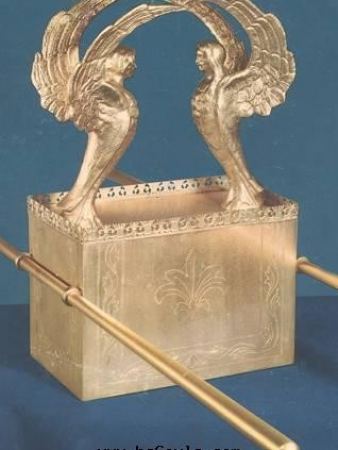
Rabbi Abraham Abulafia, the visionary and unconventional twelfth century Kabbalist, introduced a concept he called, “a whole and a half” (שָׁלֵם וָחֵצִי). At its core, this concept is mathematical, stating that we find many things in the Torah that are related to one another like a whole to a half. Many times, the two things can be categorized as masculine and feminine, with the whole representing the masculine and the half representing the feminine. Examples of a whole to a half relationship abound in Torah, with one of the strongest concentrations appearing in this week’s parashah of Terumah, which describes the construction of the mishkan, a portable Tabernacle. Many of the Tabernacle’s spatial dimensions are whole and half numbers, other dimensions have a ratio of a whole to a half between them. The following are a few examples in brief.[1]
The acacia wood panels[2] were one and a half cubits wide each. Each of the panels was supported underneath by two silver sockets; thus, the relationship of sockets to panels was 2 sockets to each panel—a 2:1 ratio, which is a whole to a half.[3] The Golden Altar, on which the incense was burned, was a cubit in length and a cubit in width and two cubits in height; thus, its height relative to its width and length was 2:1, another whole to a half relationship.[4] The courtyard surrounding the Tabernacle was one hundred cubits long by fifty cubits wide, again a ratio of 1:1/2.[5] Two sets of curtains, surrounding the inner sanctuary, each containing fifty loops were connected by fifty golden loops. Thus, one hundred loops in the curtains were connected by fifty golden hooks, a ratio of 2:1.[6]
The golden Table of Showbread, which held twelve loaves of bread, embodied a 2:1 ratio in terms of its length to width (two cubits in length and one cubit wide). Furthermore, its height was a cubit and a half. The twelve loaves were placed six on one side and six on the other; therefore, each side had half of the whole number of loaves.[7]
The Holy Ark, which housed the two tablets of the law on which were engraved the Ten Commandments, was a cubit and a half in width, a cubit and a half in height, and its length was two and a half cubits.[8] The Ark itself was actually made of three boxes—a box of acacia wood placed between two boxes of pure gold; thus, the two golden boxes surrounding an inner wooden box created a ratio of 2:1, a whole and a half. Two angel-like cherubim rested upon the Ark’s cover, another instance of a 2:1 ratio. [9] The cover’s dimensions were two and a half cubits in length and a cubit and a half in width.
Tablets and Shattered Tablets
It is important to note that not only did the Ark contain the two tablets on which the Ten Commandments were inscribed but they also housed the first broken set of tablets, which Moses smashed upon seeing the people worshipping the Golden Calf. The Ark rested within the Holy of Holies, the innermost space in the Tabernacle (and later the Temple). Chasidut explains that this holy space exists within every Jew as well and the fact that it contained both the whole and broken tablets indicates the existential reality within each person of the concept of a whole and a half.[10] The whole/broken nature of our innermost heart is reflected in what is perhaps the deepest description of a Jew found in the Zohar, which states that “Weeping is fastened to one side of the heart, [while simultaneously] joy is fastened to the other side of the heart.”[11] In Chasidic folklore, this description was at times expressed as, “there is nothing as whole as a broken heart.”[12] Finally, the Talmud expresses a similar sentiment: “The secrets of the Torah are not imparted except to one who is worried in his heart.”[13] All these statements reflect the psychological and existential counterpart to the concept of “a whole and a half.” Our deepest, innermost space contains at one and the same time both a personal feeling of wholeness and the feeling of being shattered.
The Half a Shekel
The Tabernacle’s construction and ongoing maintenance was underwritten by a series of three contributions. The first, after which this portion is named, was the people’s voluntary contribution of thirteen different materials needed to build the Tabernacle. The second was a one-time contribution of half a shekel to underwrite the cost of the silver for the sockets. The third was an annual contribution of half a shekel to purchase communal offerings for the ongoing service in the Tabernacle and later in the Temple.[14]
The half shekel contribution symbolizes the fact that every human being is simultaneously both a whole—a complete world unto him or her self—and yet merely a half, in the context of his or her relationship to the people of Israel, and ultimately to God. Each individual Jew has autonomy and is unique, but in relation to the entire people is simultaneously only a part, a “half,” of a much bigger whole. This same idea applies to an individual’s relationship with God, who is the ultimate “whole.” The half shekel contribution underwriting the Tabernacle’s construction turns the idea of a whole and a half into the very foundation on which the Tabernacle is based.
Upon further contemplation, we must recognize a great paradox underlying the concept of a whole and a half. People, in a sense, never feel more whole than when they feel close to God. Yet precisely at such moments, human beings simultaneously become aware of their great distance from God’s Infinite Being. In other words, when it comes to our relationship with God, we feel most whole when we feel we are a half. This is also true between soul mates, each one feeling whole and completed by the other, yet merely a half of a greater whole.[15]
More Examples of Shalem VaChetzi
When delving deeper into the concept of Shalem VaChetzi we see it appears not only in the Tabernacle but in a wide variety of different contexts. Let us now examine some of these.
The Shalem VaChetzi relationship is seen in the first two words of the Torah, “In the beginning [God] created” (בראשית ברא); the first word has 6 letters, the second word has 3. As stated by the sages, “Everything follows the inception.”[16] Thus, the concept of a whole and a half is encoded within the very fabric of the universe from the moment of its creation.
It is also reflected in the first two letters—yud and hei—of God’s essential Name, Havayah; the value of yud is 10, the value of hei is 5. These two letters are also considered a Name of God in their own right.[17]
The last two words of the Shema, the cardinal statement of faith in Judaism are “Havayah is one” (י-הוה אחד). The value of Havayah (י-הוה) is 26, the value of “one” (אחד) is 13. Another example of a whole and a half.[18] Thus, the absolute oneness of God is paradoxically a prime example of “a whole and a half.” As mentioned above, each individual Jew has autonomy and is unique, but in relation to God, who is the ultimate “whole,” we are all but a “half.” The phrase “God is one” illustrates this deep understanding, bringing it very close to home.
The Ten Commandments given to Moses on Mount Sinai consisted of two tablets with five commandments written on each one. The first five commandments are about the relationship between man and God,[19] whereas the second set of five commandments are about the relationship between people. Thus, the relationship of each of the two tablets to the Ten Commandments is one of a whole and a half. From this we can learn that in Judaism the commandments between man and God and man and man are each one half of the whole picture. To truly reach a spiritual whole we must implement both sides of the equation, both tablets of the law.
Apart from the large vessels in the Tabernacle, there were also smaller instruments. Two of these were trumpets: “God spoke to Moses saying: Make yourself two silver trumpets; you shall make them [from a] beaten [form]; they shall use them to summon the congregation and to announce the movement of the camps.”[20] These two silver trumpets were used by Moses during the forty years in the desert, but then hidden away. Other trumpets were made and used extensively in the Holy Temple. Whether in the desert or in the Temple, the trumpets were always blown together as a pair, while a shofar was always blown alone. In the Temple, the trumpets were often blown together with the shofar as stated in Psalms: “With trumpets and the sound of a shofar, raise your voices before the King, Havayah.”[21]
This is an interesting and paradoxical example of Shalem VaChetzi, a 2:1 ratio, as the shofar is but one-half in relation to the two trumpets.[22] Adding to this paradox is the Chasidic interpretation of the phrase “two trumpets” (שתי חצוצרות), which are read as “two half-forms” (שתי חצאי צורות).[23] This reading is based on the fact that the two trumpets were always sounded together – two instruments making one sound, thus each was considered but a half of the greater whole. The trumpets were similar to a couple who are comprised of two individuals yet form one unified entity or unit.
Shalem V’Chetzi and Time
Finally, we see that Shalem VaChetzi applies to time as well. In fact, the entire Jewish year is divided according to this paradigm.[24] The first three months of the year, beginning in Nissan, represent an ascending energy of liberation, coming out of Egypt and receiving the Ten Commandments at Sinai. These three months are marked by Passover, Counting of the Omer, and Shavu’ot. Afterwards Moses spent forty days on Mount Sinai receiving detailed explanations of the law. On the 17th of Tammuz, the fourth month of the year, he was to have returned with the two tablets of the law written with the “finger of God.” This would have been the climax of the entire process beginning with the Exodus from Egypt. 17 is the value the Hebrew word for “good” (טוב), and thus this day was to be the high point of Godly revelation. Instead, Moses returned to the people and found them worshipping the Golden Calf, precipitating a complete change in the energy of the year to repentance and return to God (teshuvah) and rectification (tikkun). This energy is still engraved in the year: the first four months are marked by spiritual ascent followed by eight months of repentance and repair. Seen in this manner, the year manifests the model of a whole and a half, but with the “half”—the first four months of the year—preceding the “whole”—the following eight months.
[1]. Ma’ayan Ganim, Terumah.
[2]. See also the article based on the Ahavat Shalom in this issue.
[3]. Exodus 26:15..
[4]. Ibid 30:1.
[5]. Ibid 27:9-13.
[6]. Ibid 26:1-6.
[7]. Ibid 25:23.
[8]. Ibid 25:10.
[9]. Ibid 25:17-19.
[10]. See HaRav Ginsburgh’s class from the 26/27th of Shevat, 5774.
[11]. Zohar 2:255, also see Tanya, ch. 34.
[12]. As taught by Rabbi Simcha Bunim and many other Chasidic Rebbes.
[13]. Chagigah 13a.
[14]. See Rashi on Exodus 25:2.
[15]. The Mystery of Marriage, pp.132-133.
[16]. Pirkei DeRabbi Eliezer, ch. 42.
[17]. Ibid p.132.
[18]. Ibid p.133.
[19]. The fifth commandment does not seem to be about the relationship between man and God. Many explanations of this seeming inconsistency have been given. One of them is that we are commanded to honor our parents regardless of whether they are honorable people, because it is the image of the third partner in our creation—the Almighty—that we honor when honoring them. Alternately, the sages state that the fifth commandment is what underwrites the intent of the first four: “Ulla the Great said: What is the meaning of that which is written ‘All the kings of the earth shall acknowledge You, O Lord, for they have heard the words of Your mouth’ (Psalms 138:4)? When the Holy Blessed One said: ‘I am the Lord your God’ (Exodus 20:2), and ‘You shall have no other gods before Me,’ the nations of the world said: ‘He demands His own honor.’ Once He said: ‘Honor your father and your mother’ (Exodus 20:11), they returned and conceded the truth of the first statements.
[20]. Bamidbar 10:1-2.
[21]. Psalms 98:6.
[22]. HaZman HaPnimi, pp.22-33.
[23]. Or Torah (Maggid of Mezritch), Beha’alotcha 134.
[24]. This idea was taught by HaRav Ginsburgh in a class on July 29, 2011.

