


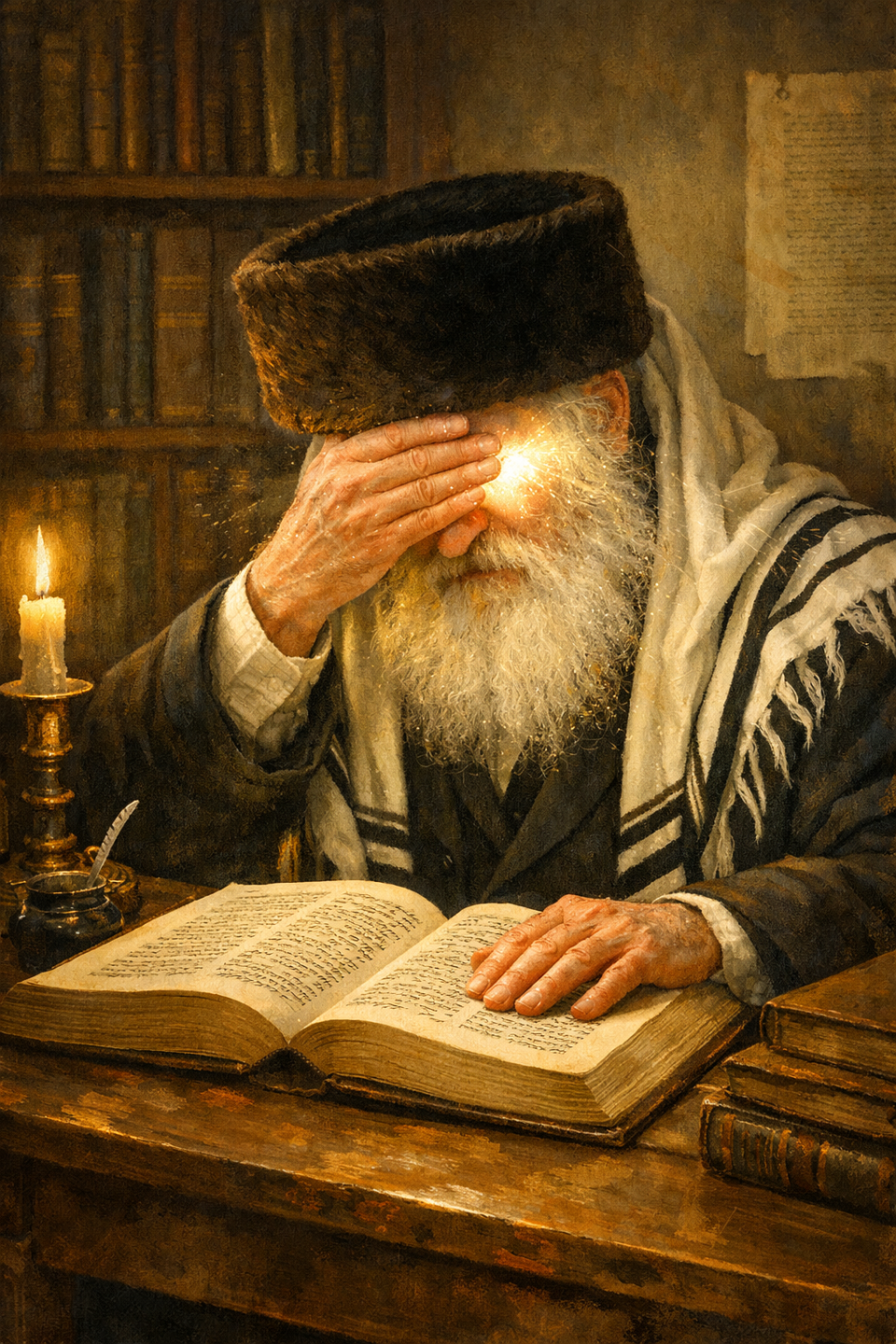
Rabbi Yaakov Yitzchak HaLevi Horowitz was also known as "the Choizeh (the Seer) of Lublin” by virtue of his wondrous ability to perceive across great distances of time and place. He was born in the year 5505 (1745) in Poland. He studied under Rebbe Shmelke of Nikolsburg and the Maggid of Mezritch, and after their passing became the foremost disciple of Rebbe Elimelech of Lizhensk. He settled in the great city of Lublin and established his court there, to which multitudes flocked. The Choizeh dispatched his most distinguished disciples to spread the teachings and way of life of Chasidut throughout Poland and Galicia. Among them were the "Holy Yid" of Pshischa, Rebbe Uri "the Seraph" of Strelisk, Rebbe Naftali of Ropshitz, and many others. The Choizeh devoted himself to hastening the Redemption and the coming of Mashiach, and on the eve of Simchat Torah 5575 (1814) he fell from the window of his home under wondrous and mysterious circumstances, in the midst of spiritual exertions to hasten the Redemption. As a result of the severe fall, he lay bedridden for nearly a year, until he departed this world on Tisha B'Av 5575 (1815). He was laid to rest in Lublin.
Once, the Choizeh traveled to visit his teacher, Rebbe Shmelke of Nikolsburg, the brother of Rebbe Pinchas, the author of the Hafla'ah, and one of the great tzaddikim among the Maggid’s disciples. The Maggid had sent the two brothers to Germany, which was comparatively less observant than Poland, and no one beside them had succeeded in kindling the light of Chasidut there. Yet for all the good they had accomplished, Nikolsburg remained a modern German city in a style the Choizeh simply could not abide. And so when he came to Nikolsburg, he tied a kerchief over his eyes and let one of the chasidim lead him.
A woman who saw someone being led with a cloth over his eyes burst into loud laughter at this strange sight. She laughed and laughed until, on account of the tzaddik’s displeasure, whether consciously or not, something very unfortunate befell her.
When the matter became known to Rebbe Shmelke of Nikolsburg, he said to his student the Choizeh: "Please, return home, and do not come here to visit. You have nothing to do in a place like Nikolsburg."
The Choizeh's quality of gevurah, or Divine severity, found its most characteristic expression in his zealousness for guarding of the eyes, ensuring that they do not see what should not be seen. It is told that when his master Rebbe Elimelech of Lizhensk departed this world, he transmitted his spiritual powers to four of his disciples: to the Choizeh he gave the power of his eyes, to the Maggid of Kozhnitz he gave the power of his heart, to Rebbe Menachem Mendel of Rimanov the power of his mind, and to the Ohev Yisrael of Apt the power of his words.
From the story we see that even before coming to Rebbe Elimelech, the Choizeh was exceedingly vigilant in all matters pertaining to his eyes and their sanctity and it was precisely for this reason that he merited this gift from Rebbe Elimelech, in keeping with the principle of "He grants wisdom to the wise" (Daniel 2:21). So it was with the other disciples who merited their respective gifts from Rebbe Elimelech.
When a tzaddik fears for the sanctity of his particular calling, he draws a quality of Divine judgment around himself. He perceives with sharp clarity the importance of his unique service, and one who is insensitive to this may come to harm. Through this power the Choizeh would inadvertently spiritually strike those who treated his honor lightly, even when no such intention was in his heart.
Yet many tzaddikim conducted themselves in a different manner. It is told of Rebbe Baruch of Mezhibuzh (the Ba’al Shem Tov’s grandson) that when the Choizeh came to visit him, the women of the household entered the room where the tzaddik and the chasidim were gathered, to hear the words of Torah at the third Shabbat meal. The Choizeh turned to Rebbe Baruch in great astonishment: "Is it not written, 'Turn away my eyes from beholding impropriety?'" Rebbe Baruch replied: "It is not written 'turn impropriety away from my eyes.' Rather it states the opposite: if there is impropriety present, I simply do not see it."
Similarly, when Rebbe Shmelke of Nikolsburg heard what had occurred, he sent the Choizeh home. Rabbi Shmelke's work was to draw the people of his city closer to God. To enter the world of Jews for whom life is still distant from revealed holiness, one must be sensitive to their latent sanctity. Even if this demands setting aside one's personal service of God, one must be willing to descend into places of less repute to bring out the diamonds hidden within.
In contrast to the difficulties that arise from such a mismatch, when the Choizeh encountered Jews who were vessels fit to receive, his extraordinary holiness worked within them in deeply blessed ways:
One of the tzaddikim who was a disciple of the Choizeh was Rebbe Shalom of Kaminke. As a young scholar he was known as a prodigious genius, but was not a chasid. As was the way in those times, a wealthy man took him as a son-in-law with a promise to support the family for many years and to provide a generous dowry. The prospective father-in-law, however, made the agreement conditional upon their traveling together to the Choizeh of Lublin who would bless the young man and test his Torah knowledge. The prospective groom and his father agreed, and the two set out to the Choizeh.
When they arrived, the Choizeh called for his attendant to bring the Book of Leviticus and read from it. When Rebbe Shalom later recounted this to his friend, the Imrei Noam, he said: "Believe me, when he asked them to bring the Book of Leviticus, I nearly burst out laughing. This is how they test me? I need to be tested on complex Talmudic intricacies, not on Leviticus!" The Rebbe opened the book to the beginning of the Torah portion of Kedoshim and asked: "Do you know what Rashi writes on this?" Again Rebbe Shalom suppressed his laughter at such a question and said: “Be separated from sexual immorality and from transgression.” The Rebbe said: “Let us recite this Rashi together,” and they began to say it together. At that very moment, the tzaddik related, a trembling and shuddering seized my entire body. I trembled so violently that I had to lie down. For many hours I shook, and I was truly dangerously ill. Even today, when I recount this story, I begin to tremble throughout my entire body.
Another great tzaddik of Poland, the author of the Tiferet Shlomo, related that his father had brought him to the Choizeh when he was a child. The Rebbe took him aside and said to him the very same thing: “Do you remember what Rashi writes on ‘Kedoshim tihiyu’ (You shall be holy)? Let us say it together: ‘Be separated from sexual immorality and from transgression.’” The author of the Tiferet Shlomo later testified that, thank God, he had never in his life stumbled in the blemish of the covenant, by virtue of those words he had heard as a child.
In two stories that are actually one, the Choizeh's power is revealed: the power to take a simple sentence from the Torah and through it transform the entire lives of two people. The young child became a guardian of the covenant in the most natural way, while the brilliant opponent of Chasidut who had presumably understood far more than the child what “immorality and transgression” entailed trembled through his entire body. Ultimately, both became great tzaddikim who guided multitudes in the path of God.
As befits a story concerned with the sanctity of procreation, what is revealed here is not only temperance and fear of sin. Rather, in these stories, the tzaddik makes his chasidim fruitful and triggers a profound transformation within them, one that bears fruit for entire lifetimes and for generations upon generations, just like an act of procreation.
The anniversary of passing of the Choizeh falls on the 9th of Av, the day on which Mashiach is born. The Mashiach embodies the perfection of the rectification of the covenant and the fulfillment of the commandment, “Be fruitful and multiply and fill the earth” (with holiness and with purity). This is the Torah’s first commandment. Having offspring is referred to as “the great commandment” (where “great” invokes and suggests augmentation), the commandment that inter-includes the entire Torah. Revealing this essential connection between the Choizeh and his day of passing is revealed in the equality between the numerical value of Tisha B'Av (תִּשְׁעָה בְּאָב) and “Joseph” the archetypal soul of the power of procreation and “the guardian of the covenant,” when Joseph is written in a special way (known as panim ve’achor) by the Arizal, as follows: Tisha B’av is 780 and “Joseph” front and back (י יו יוס יוסף יוסף וסף סף ף).
In addition, the value of “Mashiach is born on Tisha B’av” (בְּתִשְׁעָה בְּאָב נוֹלַד הַמָּשִׁיחַ) is equal to the Ezekiel’s exclamation describing God’s holiness, “Holy, holy, holy [is Havayah, God of Hosts]” (קָדוֹשׁ קָדוֹשׁ קָדוֹשׁ) where once again, the holiness is an inherent sign of those who protect and safeguard the covenant.

