


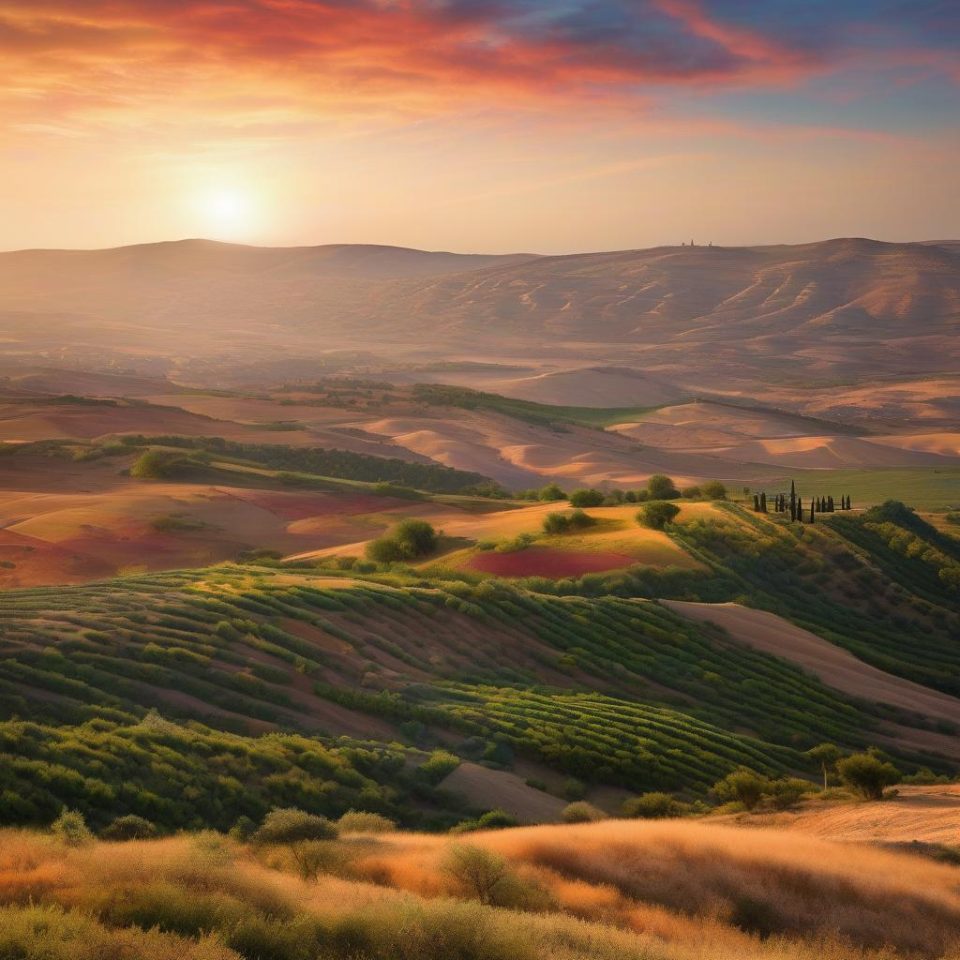
The most picturesque descriptions of the Land of Israel in the entire Torah are in this week’s parshat Eikev. For example:
For Havayah your God is bringing you to a good land, a land with brooks of water, fountains and depths, that emerge in valleys and mountains. A land of wheat and barley, [grape] vines and figs and pomegranates, a land of oil producing olives and [date] honey. A land in which you will eat bread without scarcity, you will lack nothing in it. A land whose stones are iron, and out of whose mountains you will hew copper. And you will eat and be sated, and you shall bless Havayah, your God, for the good land He has given you.”[1]
Another example:
For the land that you are coming there to inherit it is not like the Land of Egypt that you left there, where you would plant your seed and irrigate it with your foot like a vegetable garden. But the land that you cross over to inherit is a land of mountains and valleys; from the rain of the heavens, you shall drink water.”[2]
Perhaps the most powerful verse is the one that expresses God’s relationship with the land:
A land that Havayah, your God, seeks out; the eyes of Havayah, your God, are always on it, from the beginning of the year until the year’s end.[3]
Commenting on this verse, Rashi at first cites a verse from Job that seems to indicate that God seeks out the welfare of all the lands, not just the Land of Israel; however, he quickly explains that God’s attention is directed first and foremost at the Land of Israel, and through this all the other lands are included. This interpretation stresses that not only is the Land of Israel special but also that what occurs in Israel has a profound impact on the entire world. The Sages taught that had the nations of the world understood how beneficial the Temple in Jerusalem was for them, how much their own affluence and success depended on its impact, they would have appointed their own guards to protect it.[4]
This statement carries special relevance today when Israel, though barely a dot on the world map, is at the very epicenter of international politics, global economics, and technological advances; and, of course, religion. Given the country’s miniscule size and relatively small population, its importance exceeds all expectations. Yet the answer to this paradox lies in the verse we are discussing: the world’s eyes are focused on this very place because God’s eyes, as it were, are focused on it. In fact, the world’s obsession with the Land of Israel has been evident throughout history as one empire after another has sought to control the Land of Israel, the spiritual and geographical crossroads of the world.
God’s Divine Providence
The phrase “the eyes of God,” or God “looking” or “seeing,” found throughout the Tanach, are a metaphor for God’s Divine Providence.[5] The Sages taught that this verse teaches us that God judges the world on Rosh HaShanah—for the verse explicitly states that His eyes are always on the Land from “the beginning of the year”—and that the judgment’s scope is for the entire year, as the verse states, “until the year’s end.”[6] The Hebrew word translated as “beginning” (מֵרֵשִׁית) has the same Hebrew root as the Torah’s first word: “In the beginning [God created the heavens and the earth]” (בְּרֵאשִׁית). Commenting on this verse, Rashi explains that the phrase “in the beginning” could be interpreted to mean “for the sake of the beginning.” He then quotes two verses that imply that the Torah and the people of Israel represent two aspects of “beginning,” inferring that for the sake of both the Torah and of the Jewish people, God created the heavens and the earth.[7] This explains why the “eyes of God” are always focused on the Land, for this is the place where the Jewish people are meant to fulfill the Torah and create a society that would be a light unto the nations, the place from which God’s ultimate purpose for creation would eventually shine forth to envelop the entire world.
The Concept of Holiness
The Land of Israel has been known as “the Holy Land” for millennia. To understand this idea, it behooves us to try to define the abstract concept of holiness. Perhaps, the easiest way to define it is by exploring how holiness is attained. Kedushah (holiness or sanctity, in Hebrew) is attained through separation, as that is the literal meaning of the word. By distancing ourselves from evil, impurity, and various worldly energies that block our spiritual channels and sensitivities, we become proper vessels, capable of receiving and radiating holiness. Indeed, one of the fundamental premises underlying the mitzvot is the constant requirement to separate and distinguish between good and evil, pure and impure, permitted and forbidden, and between sacred time and space and mundane time and space.
However, along with the notion of separation, holiness is also associated with designating, assigning, and choosing. In the Temple period, an animal or object that was chosen and then designated to be sacrificed or donated to the Temple was called hekdesh (a word which stems from the same root as “holiness” and which literally means “sanctified”). Thus, designation and choice are fundamentally connected to the concept of holiness. Ultimately all holiness emanates from God who declares to the Jewish people: “You shall be holy, for holy am I, Havayah your God.”[8]
The connection between designation, choice, and holiness is seen clearly in the Temple in Jerusalem. In next week’s parashah, Re’eh, the following idea is mentioned numerous times in slightly different ways, that one can only bring offerings to God “to the place that Havayah your God will choose,” or “only to the place that Havayah, your God, will choose from among all your tribes to place His name.”[9] It is significant that the Sages referred to the holy Temple in Jerusalem as Beit HaMikdah, the House of Holiness/Sanctity as well as Maimonides’ reference to it as Beit HaBechirah, the House of Choice or the Chosen House.[10] It is explained in Chasidut that not only does the Temple manifest God’s Presence and holiness due to his choosing its place but one who visited the Temple was inspired and infused with the power to be holy and to exercise free choice correctly.[11]
In fact, most of the concepts we associate with holiness and are called holy, such as the Hebrew language, Torah, Shabbat, the Jewish people, the Land of Israel, Jerusalem, and the Temple, attained this stature because God chose them.
The Torah and the Hebrew letters were designated by God as His blueprint for creation, as the Zohar teaches: “God looked into the Torah and created the world.”[12] Thus, when we look to define “holiness,” we look for the first time the root for holiness and sanctification appears in the Torah. We find it for the first time when God designates Shabbat, the seventh day, as holy:
And the heavens and earth were completed and all their array. By the seventh day God completed His work that He had done, and He abstained on the seventh day from all his work that He had done. God blessed the seventh day and sanctified it (vayekadesh, from the infinitive verb “to be holy”), for on it He rested from His work, which God created to make.[13]
God’s choice of the Jewish people began with his selection of Abraham. Although Abraham certainly exercised his own intellect to discover that God is one, God had already realized Abraham’s potential and chose him from among all the peoples to reveal His oneness to the world. In the morning prayers we recite the following:
It is You, Havayah, the God Who selected Abram, brought him out of Ur Kasdim and made his name Abraham. And You found his heart faithful before You….[14]
In the case of the Land of Israel, the inherent holiness of the land is apparent from the first instruction God gave Abraham: “go … to the land that I will show you.”[15] Clearly, Abraham was not being instructed to wander until he happened to find a place he liked. Rather, Abraham was being led to a specific land that God had already chosen. The fact that God brought him to a particular place implies that the land possessed particular spiritual qualities and energies that God deemed important for Abraham and his descendants.
The Glory of God Revealed
In the book of Isaiah, the prophet records his dramatic vision:
In the year that King Uzziah died, I saw God sitting upon a high and exalted throne, and His train filled the Temple. Seraphim stood above Him; each had six wings, two covering the face, two covering the feet, and two with which they flew. And one called to the other, “Holy, holy, holy is the Lord of Hosts; the whole earth is full of His glory.”[16]
The angels’ proclamation “Holy, Holy, Holy” has become one of the central declarations of Jewish prayer. Recited twice daily in private prayer, and four times when praying with a congregation, it links us with the very song of the angels.
In our prayers, we incorporate a verse from Ezekiel that has different angels responding to those proclaiming God’s holiness: “Blessed is the glory of God from His place.”[17] An amazing numerical gem: the word “glory” (כָּבוֹד) has the numerical value 32, while the four-letter Name of God, Havayah (י-הוה) has the value 26. Multiplying these words by each other equals 832, the gematria of “the Land of Israel” (אֶרֶץ יִשְׂרָאֵל).[18] Thus, when we say, “Blessed is the glory of God from His place,” we are not only affirming His transcendent majesty in the upper worlds, but also alluding to its most perfect dwelling place, here on earth, in the Land of Israel.
Eretz Yisrael, the Land of Israel, is the center of holiness, the earthly vessel for God’s Presence, the Shechinah. Even when its light is obscured in the eyes of the world, we must never forget this truth: the land itself is the physical embodiment of “the glory of God.”
This glory is a result of God’s “eyes,” meaning, His Divine providence, being centered and focused on Eretz Yisrael at all times. God seeks it out with the purpose of fulfilling His own desire to have a dwelling place in the lower worlds. The complete revelation of God’s holiness and providence is the destiny toward which all history flows and is the hope that sustains us until redemption is complete.
[1]. Deuteronomy 8:7-10.
[2]. Ibid 11:10-11.
[3]. Ibid 11:12.
[4]. Bamidbar Rabbah 1:3.
[5]. The Hebrew Letters, p. 238.
[6]. Rosh HaShanah 8a.
[7]. Torah is referred to as “the beginning of His ways” in Proverbs 6:22. Israel is called “the beginning of his produce” in Jeremiah 2:3.
[8]. Leviticus 19:1.
[9]. Deuteronomy 12:18; 12:4.
[10]. The Hebrew Letters, p. 46.
[11]. Ibid.
[12]. Zohar 2:161b; See the entire introduction to The Hebrew Letters for an in-depth understanding of the Hebrew letters and their role in creation.
[13]. Genesis 2:1-3.
[14]. Nechemiah 9:7.
[15]. Genesis 12:1.
[16]. Isaiah 6:1-3.
[17]. Ezekiel 3:12
[18]. Yaiyn Yitzchak, Eikev 35.

