


Rebbe Gedaliah Moshe Goldman was the fifth Rebbe of the house of Zvhil. Born to Rebbe Shlomo of Zvhil, he married the daughter of Rebbe David Shlomo of Kobrin. After his father made aliyah to the Land of Israel, he was appointed in 5686 (1926) as rabbi of the town of Zvhil in Ukraine, where he became known as a holy man; he was strict with himself, and as lenient as possible with others. He was persecuted by the Soviet authorities for his devotion to Torah and its commandments and was sentenced to seven years of forced labor in Siberia. Even there he showed unwavering faith and courage, telling his judges that nothing in the world happens without permission from Heaven. After his release he served for a time as rabbi in a town near Moscow, and in 5697 (1937) he succeeded in escaping the Soviet Union and making aliyah to the Land of Israel. In Jerusalem he lived in modesty, and in 5705 (1945), after his father's passing, he began to serve as Rebbe of Zvhil. He passed away on the 24th of Cheshvan, 5710 (1949), and was buried in the Givat Ram cemetery; his grave has since become a place of prayer for many.
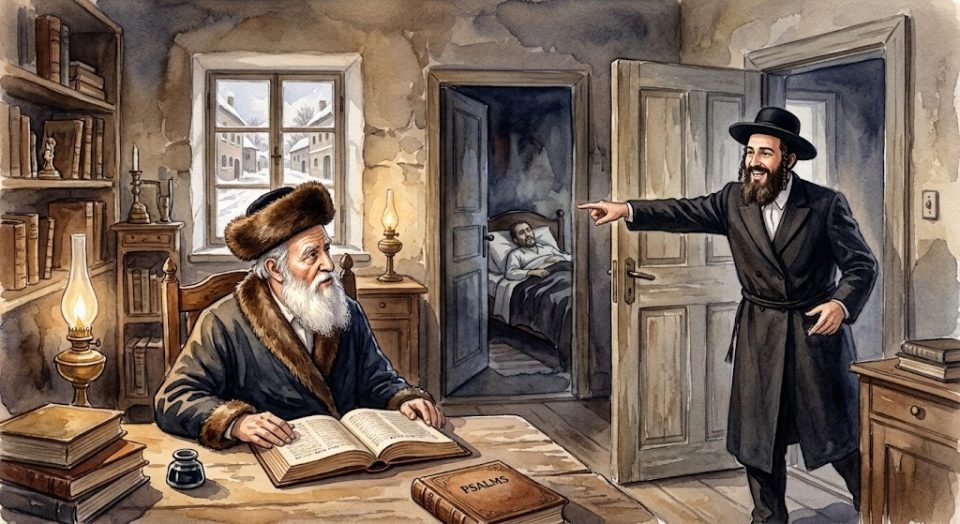
Our Rebbe [Rebbe Gedaliah of Zvhil] related that the Maggid of Zlotchov, of blessed memory, once came to Mezritch and asked to be admitted to the house of the Maggid of Mezritch. Members of the household told him that the Rebbe was in great distress over a family member who was gravely ill and hovering between life and death. Therefore, the Rebbe was receiving no one. The Maggid of Zlotchov nonetheless asked to be let in. He opened the door, approached the Maggid of Mezritch, and said to him: "I do not understand why the Rebbe is troubled. Surely this sick man will be eating with us at this evening's meal!" And indeed, the sick man recovered, and joined them at the evening meal.
Afterward the Maggid remarked that he himself had seen no natural path to the patient's recovery; it was the Maggid of Zlotchov's words, filled with trust, that had taken effect.
On another occasion he said to his student, Rabbi Eli Rotta: "The measure of trust that I myself hold is to believe that whatever comes to be in the world, and whatever will be, is all for the good. There is, however, a higher level in which, through the strength of firm faith, one draws down the very thing one seeks."
"Do you wish to know what trust is?" our Rebbe once turned to his student, Rabbi Eli, and said, "let me tell you."
In Zvhil, in those generations, it was the custom to betroth daughters at the age of twelve, while the wedding itself would not take place until three years later, at fifteen. Those three years were meant for gathering a sum of money, coin by coin, toward the expenses of the marriage. I knew a Jew, a resident of Zvhil, who betrothed his daughter, and, as was customary, gathered a considerable sum over the years between the betrothal and the wedding.
The Jew reasoned with himself: the Sages taught that all the sustenance a person will receive during the entire year is allotted to him from the first day of the year, from Rosh Hashanah. But this does not include the expenses for Shabbat and festivals. Now, he thought to himself, surely money spent for others' sake in honor of Shabbat likewise falls outside the yearly allowance. Since Zvhil had many poor and destitute people who lacked the means for their Shabbat needs, it seemed only right that the sum now in his hands should be distributed among these poor individuals to buy their needs for Shabbat and festivals, since this money would fall outside his own personal allowance. In this way the poor would gain, while he himself would lose nothing at all from the transaction.
He did indeed distribute the money for the Shabbat needs of the poor of the city, and from then on made a practice of giving a considerable sum to the poor every Wednesday. Heaven assisted him: the money for the approaching wedding was not lacking either, and everything worked out for the very best. From that time the custom spread throughout Zvhil that every Shabbat eve, wagons laden with food would go out to those in need. Our Rebbe concluded his story to Rabbi Eli by saying: "This is faith!"
Rabbi Eli listened to the story with great seriousness, but did not dare ask his Rebbe who that Jew had been. It occurred to him, perhaps, that the wondrous Jew was none other than the storyteller himself.
To properly appreciate these moving stories, let us note, as is our way, the distinctions between the different expressions of faith found in them (the distinctions are the topic of HaRav Ginsburgh’s article Emunah VeBitachon in his volume Lev LaDa’at which he elucidated in length in a series of classes with the same title between 5777 and 5782). Though Rebbe Gedaliah Moshe describes all three by the same words, “faith” and “trust” interchangeably, we will differentiate between their correspondence to one of three facets of a Jew's reliance on God: faith (emunah), passive trust (passive bitachon), and active trust (active bitachon).
Faith—the most basic and passive of the three—is the one Rebbe Gedaliah Moshe testifies that he himself holds: simple faith in God's goodness and Providence, which removes all fear of negative events. Passive trust intervenes, as it were, in the Divine calculus through one’s plans, thoughts, and anticipation about the future. One who is exercising passive bitachon is confident that his intentions and thoughts carry weight, and that the Holy blessed One will direct one's life on the path desired by the person. This level resembles the story of the Maggid of Zlotchov, who was certain the sick man would recover, and was not merely comforting the Maggid of Mezritch with the words "all is for the good." Yet, the Maggid of Zlotchov did not do anything active. He simply anticipated that God would bring him healing.
The third level, the most striking of all, is the one the Rebbe of Zvhil demonstrates his trust in God through his actions, not just through his good thoughts and plans. He himself gave vast sums of money intended for his daughter's wedding, in complete trust that God would not disappoint him. This is known as active trust, active bitachon: trusting in God not for an abstract Divine good, nor even for the a good outcome (as I understand it) that will just unfold but, for the good that God brings about specifically through me, through my own actions in the world.
Indeed, the primary expression of faith and trust in God is to give abundantly to charity with one's money, one's body, and one's soul alike. To be utterly devoted to another, whether materially or in spreading the wellsprings of Torah outward, is the hallmark of one who has active trust in God. Such an individual gives of his whole self, effectively surrendering himself to give charity and to help a fellow Jew. In such charity, faith too is present—faith that every Jew is worthy of one surrendering oneself for his sake. Beyond this, trust is also required: trust that however much one gives to another, nothing will be lacking from one’s own needs.
Abraham, the head of all believers, was also the first one who trusted in God. Of him it is said, “And he believed in God, and He [God] counted it to him as a charity" (Genesis 15:6). Abraham embodied his faith and turned it into trust and this trust was the source of his extraordinary loving-kindness towards others, as it says "He who trusts in God shall be surrounded by loving-kindness" (Psalms 32:10). Divine loving-kindness flows through the one who trusts in God expressing itself as boundless giving. On the verse from Genesis, it is taught in Chasidut that, "faith is counted as charity," and likewise that "faith is the result of charity." Faith and trust are bound to charity by a deep connection, and one who truly trusts in God gives to charity without limit.
(adapted from the class of 22 Tammuz 5779)

