


Nimrod: The First King
The month of Cheshvan relates to the inner faculties of the kingship.[1] It is very fitting that in our public reading of the Torah, we read about the first king in the month of Cheshvan, specifically in parashat Noach.
There is a principle in Torah (and in general) that “everything follows the inception.” When one wants to know anything in the Torah—a person, a concept, a story—one must find its first appearance in the Torah, or in history,[2] upon which all the similar concepts and events that follow are based. Kingship begins from a certain point, from a certain place. Adam, the first man, was not a king (over a nation); his son Seth was also not a king, nor was his grandson Enosh. Who was the first king? How many generations must one wait, from the creation of Adam until the first king?
The answer 13 generations—three generations after Noach, who was the tenth generation from Adam, the tenth generation of humanity. Noach had three sons. One of them was Ham, who had a son named Kush (Ethiopia), and Kush gave birth to Nimrod—the first king in history, as documented in the Torah,
And Kush begot Nimrod; the first man who was mighty in the earth. He was a mighty hunter before God…. And his kingdom began with Babylon, and with Erech, and Akkad, and Kalneh, in the land of Shinar.[3]
If kingship begins with Nimrod, one must become acquainted with this soul. He was not a tzaddik; he was wicked. We know his wickedness through Abraham, the first Jew and our first patriarch, whom he persecuted on account of his faith in one God. After Abraham broke the idols in his father’s shop, Nimrod tried to kill him by throwing him into the fiery furnace, but Abraham was miraculously saved when God Himself saved him.[4]
Nimrod was the king of Babylon, and he was behind the building of the Tower of Babylon. In the story of the Tower of Babylon itself, the name Nimrod does not appear, but in the account of the generations of Noach it is written of him, “and the beginning of his kingdom was Bavel”—so it is very clear that he is the one who led the story of building the city and erecting the tower. It is written that the idolatry of Babylon, which began with Nimrod and ended with Nebuchadnezzar was called Bel, like Babel, somewhat reminiscent of the Ba’al, the chief idolatry in the Land of Israel during Biblical times. Nimrod built the capital city of Babylon, and everything connected to Babylon[5] comes from him. Even good things connected to Babylon like the Babylonian Talmud.
The way we live today as Jews is in large measure derived from the Babylonian Talmud and not, as one might suppose, according to the later Jerusalem Talmud. As a result, to this day, there is something very foundational in our lives still connected to Babylon.
Nebuchadnezzar: Nimrod’s Reincarnation
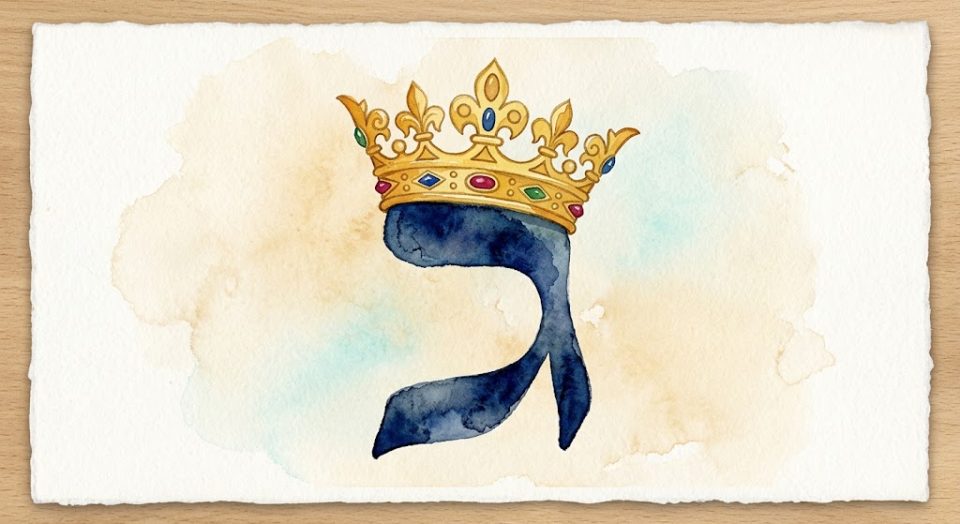
What do we know in Kabbalah about Nimrod? The first thing that is clear is that his name begins with the letter nun, the letter of this month, Cheshvan, whose meaning we said is king.
The Arizal, the greatest of the Kabbalists, teaches us that Nimrod returned in reincarnation a second time as Nebuchadnezzar. Nebuchadnezzar was the king of Babylonian empire, like Nimrod, and he is the king who destroyed the First Temple. In Nebuchadnezzar (נְבֻכַדְנֶאצַּר), the letter nun appears twice. Nebuchadnezzar is understood to be composed of two words—Nebuchad-nezzar. The second part, nezzar means emperor or king. So essentially, both parts of his name begin with the letter nun.
Again, according to the Arizal, Nebuchadnezzar was a reincarnation of Nimrod. According to the Talmud—the Torah’s revealed dimension—he was a physical descendant of Nimrod. But the Talmud adds another astonishing fact: that he was also a descendant of King Solomon, who built the First Temple that Nebuchadnezzar destroyed. How could this be?
Scripture recounts that the Queen of Sheba came to witness Solomon’s wisdom and the greatness of his kingdom. When in Jerusalem, she asked him for something (which is not mentioned explicitly in Scripture. The Sages reveal that she asked to bear a child from Solomon, and that he granted her request.[6] According to the sages, the child born from this union was Nebuchadnezzar, which might mean that Nebuchadnezzar descended from this child a few generations later.
Nero Caesar
There is one more important non-Jewish king whose name begins with nun and who was connected with the destruction of the Temple, this time the Second Temple. This was Nero, the Roman emperor, who in the Talmud is known as Neron Caesar (נֵירוֹן קֵיסָר). His name begins with nun and ends with nun and contains all the letters of the name of the letter nun (נון), which means “king,” as above.
The most famous gematria in the non-Jewish tradition is 666. For many non-Jews this is a frightening number, associated with what they call the “Antichrist.” The true significance of this number is that it is the value of Nero’s name when written in a particular manner (נֵרֹון קֵסָּר). Clearly, the connection is vague because both words are written with defective spelling. Nero is considered the Antichrist according to the false non-Jewish tradition—so much so that they believe he will return to fight against the Mashiach.[7]
There is a little grain of truth behind these fantastic tales. In the Babylonian Talmud, our true tradition, it is written that at the end of his life, Nero converted to Judaism, and that Rabbi Meir, the great disciple of Rabbi Akiva, was among his descendants. According to some non-Jewish Roman historians, Nero committed suicide at a young age, but according to others, he simply disappeared. There are even gentiles who think that he never died, that he is still wandering about—the “anti-” of their messiah. For us it is very simple that he is the father of a messianic figure, that Mashiach is among his descendants—this is an astonishing lineage. Of all the Sages of the Mishnah, Rabbi Meir was the only one who regarded himself as having the potential to be Mashiach. The fact that the only messianic figure in the Mishnah is Rabbi Meir and that he is a descendant of Nero, about whom there is an entire story in the Talmud of what led him to convert at the end of his days.
The Return of the Sparks of the Wicked
We have seen the rectification of Nero, who converted at the end of his days. Is there a rectification for Nebuchadnezzar? Could there also be some rectification for him? According to the Sages, Nero has a rectification—what about the two before him, Nimrod and Nebuchadnezzar? The point we are trying to reach, the salient headline from this entire discussion is that even the most wicked kings in history—those who destroyed the Temples, the Jewish values and culture, and killed millions of Jews—even they have some type of rectification. Not only is there some rectification for them, but there is within them a spark of Mashiach. Within these wicked people there are messianic sparks that must be redeemed and when we succeed in redeeming them, the true Mashiach will be able to appear and redeem us all.
What we have just said fits perfectly with what we have been discussing in recent years about the Fourth Revolution in Torah learning, which is about permitting and even requiring us to teach Torah to the entire world. Torah has the special quality that it can draw out of these kings, like a magnet pulling metal filings, the lost sparks of holiness that are concealed within them. As we explain in length regarding the Fourth Revolution, we are now in the final stages of our long exile, a stage that is meant to redeem sparks of holiness from among the nations of the world. These sparks are redeemed when non-Jewish convert to Judaism. Until all the sparks lost among the nations return to Judaism and are rectified, the final redemption will not come; Mashiach cannot come.
According to the Sages, all the well-known wicked people had descendants who studied Torah—not only Nimrod and Nebuchadnezzar, but also Sancheriv, Pharaoh, and the like. There is a discussion in the Talmud whose conclusion is that all the wicked kings who destroyed and killed Jews and even those who only plotted against us, like Haman, had descendants who converted and studied Torah.
[1]. See the previous article in this issue.
[2] Sometimes the order of the Torah is not the order of history—“there is no chronological order in the Torah”—and then the main thing is the order of events described in the Torah.
[3]. Genesis 10:8-10.
[4] See Pesachim 118a: At the moment when the wicked Nimrod cast Avraham Avinu into the fiery furnace, Gavriel said before the Holy blessed One: “Master of the universe, let me go down and cool [the fire] and save the righteous one from the fiery furnace.” The Holy blessed One said to him: “I am unique in My world, and he is unique in his world; it is fitting for the Unique One to save the unique one.” And since the Holy blessed One does not withhold reward from any creature, He said: “you will merit to save three of his descendants [i.e., Chananyah, Mishael, and Azaryah].
[5] See also the essay “Mapelet Bavel” in our Hebrew volume, Rucho Shel Mashiach.
[6]. This is hinted to in the verse (1 Kings 10:13), “and King Solomon gave the Queen of Sheba all she desired, all that she requested.”
[7] Using the correct Hebrew spelling, the value of “Nero” (נֵירוֹן) is the same as “that man” (הָאִישׁ) referring to Jesus” (יֵשׁוּ). This is as it turns out is an even better allusion to Nero being an anti-Messianic figure than the whole idea about 666. According to Christian history, Nero was the one who killed the two chief apostles, Peter and Paul. It is said that when he returns, he will also defeat “that man,” the reason that he is feared as an anti-Christ.

