


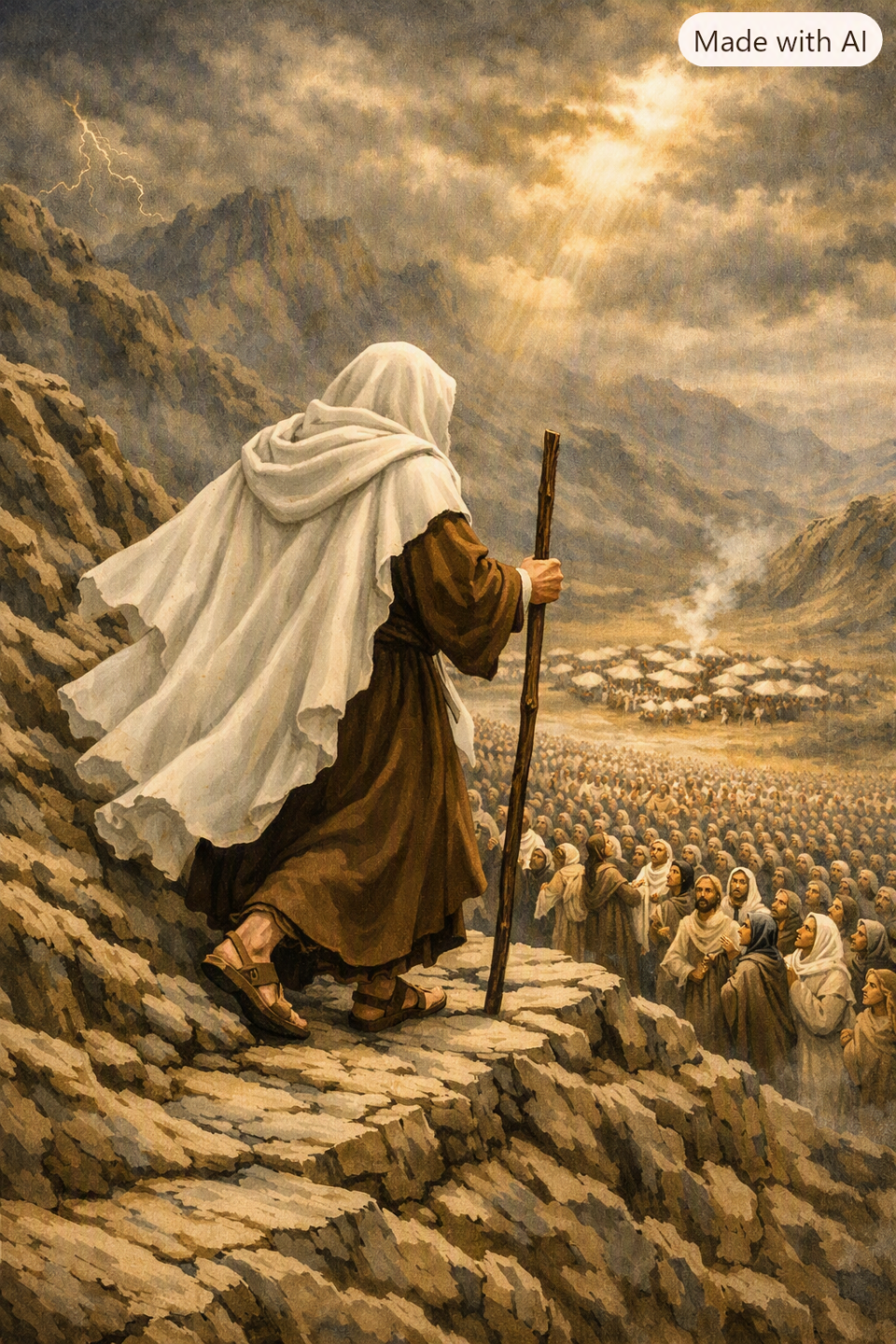
We are currently in the second week of the Month of Elul, the last month of the year, which serves as a preparation for the coming year (may it be a good and sweet year for us all) and particularly for the Ten Days of Teshuvah that begin with Rosh HaShanah and end with Yom Kippur. Elul is known as the month of compassion and forgiveness. This is because Moses spent his third set of forty days on Mt. Sinai during the month of Elul and the first ten days of Tishrei—the Ten Days of Repentance.[1]
The first time Moses ascended the mountain for forty days, he received the Tablets of the Covenant inscribed with the Decalogue on them but shattered the Tablets upon learning that the people had sinned by constructing the Golden Calf. He then ascended a second time for forty days to beg God not to destroy the people. During his third ascent for forty days, God told him that He had forgiven the people and then revealed His Thirteen Attributes of Compassion, instructing Moses to call upon these attributes whenever there seemed to be decree or harsh judgment against the Jewish people.
The Sephardic custom is to indeed recite the Thirteen Attributes of God’s compassion every day during this time period (except on Shabbat) during the Selichot. Ashkenazim join them in the final week or so before Rosh HaShanah. But even when these Thirteen Attributes are not recited vocally, they are hanging in the air of Elul and the Ten Days of Teshuvah motivating us to take a deeper look at them.[2]
One of the aspects of the Thirteen Attributes that is not well understood is that Kabbalah recognizes that they appear in both the Pentateuch and in the Prophets. In the Pentateuch they are enumerated in their place in Exodus. In the Prophets, Kabbalah identifies the Thirteen Attributes in a passage from the Book of Micah. We recite this passage on the first (or second) day of Rosh HaShanah during Tashlich. We will get to that but let us begin with the Thirteen Attributes as they appear in the Book of Exodus.
To gain further insight into these, we will explain the correspondence between the Thirteen Attributes and the Thirteen aspects of the soul. Regarding Creation, we usually identify 10 sefirot from crown to kingdom. Particularly when speaking of how the sefirot manifest through the soul, we speak of 11 sefirot, including the sefirah of knowledge (or da’at). However, the crown itself divides in the Zohar into three separate “heads,” which are identified in Chasidut with the faculties of faith, pleasure, and will. We thus have 13 faculties in total.
There are different methods for enumerating the Thirteen Attributes of Compassion from the verse in Exodus. Here we will follow the method employed by the Zohar and the Arizal:
Havayah passed by before him [Moses] and proclaimed: “Havayah, Havayah [1] [is a benevolent] God; [2] compassionate and [3] gracious; [4-5] slow to [demonstrate His] anger; [6] abounding in kindness; [7] and truth [faithfully rewarding those who obey Him]. [8] He preserves [the merit of the acts of] kindness [9] for thousands [of generations]; [10] He forgives premeditated sins, [11] as well as rebellious sins, and [12] unintentional sins; [13] And He acquits [those who repent]….[3]
God and Faith
God’s Name Kel (אֵ-ל), which is the first attribute alludes to the verse that connects this Name with the faculty of faith, “A faithful God without iniquity, righteous and upright is He.”[4] Kel is the holy Name revealed by Abraham, the archetypal soul of kindness and love, a connection appearing in many verses, among them “Loving-kindness to Abraham,” and “Abraham who loves Me.” Indeed, the Name Kel is also associated with kindness in the verse, “The kindness of God is all day long.”[5] Abraham revealed this name after his war with the Four Kings, as it is written, “And he called there upon the Name of Havayah, Kel-world.” The juxtaposition of Kel and world negates the notion that God is separate from the world. It is a meant to make public the Abrahamic faith that there is nothing that is outside of God. By proclaiming God as “Kel-world,” Abraham made public His pure faith in God’s absolute unity. Abraham is therefore described as the head of all believers, meaning that he draws faith into others as well. Faith itself is the highest head of the three heads of the sefirah of crown.
Compassionate and Compassion
There is no great surprise that the second attribute, “compassionate” corresponds to compassion (רַחֲמִים), the inner experience of the sefirah of beauty (tiferet); not much needs to be explained here. However, being that the attribute “compassionate” is grammatically part of the first genitive construction found in the Thirteen Attributes, “compassionate God”—a construction of Kel and Compassionate—we are led to look at the sum of “faith” (אֱמוּנָה) and “compassion” (רַחֲמִים), which is 400, or 20 squared. When the sum of two words is a square number, this indicates an inherent connection between them. In this case, it is explained in Chasidut that God’s inherent ousia (the ancient Greek term for an essential essence, עֶצֶם in Hebrew) is faith and the beginning of His revelation of Himself is through compassion.
Gracious and Lowliness
The third attribute of compassion relates to grace. About grace we find two complementary verses, “A woman of grace attains honor,”[6] and “A lowly spirit will attain honor.”[7] When considering that both a woman and honor are expressions of the sefirah of kingdom (malchut), the second verse connects kingdom with lowliness. This is one of the main reasons for identifying the inner experience of kingdom with lowliness. Lowliness was also the essential character trait of King David, the archetypal soul of kingdom, illustrated in his words, “I will be lowly in my own eyes.”[8]
Finds grace in the eyes of those who see us thus depends upon being of a lowly spirit. Lowliness does not mean depression or self-deprecation. Rather it means that one is fully aware of one’s shortcomings and therefore does not condescend to others. God’s attribute of grace is thus given to those who are of a lowly spirit. Grace is one of 8 synonyms for beauty in Hebrew. These 8 synonyms correspond to the sefirot and grace in particular corresponds to kingdom.
Sefer Yetizrah enumerates seven transformations or opposites, that correspond to the seven lower sefirot, from loving-kindness to kingdom. The seventh, corresponding to kingdom is “The counterpart of grace is ugliness.”
The third attribute, gracious, is prefixed with a conjunctive “and” to the previous two. Indeed, it is faith—through it power to bear opposites—that forges the primary Kabbalistic spiritual union between the sefirah of beauty (here “compassionate”) and kingdom (here “gracious”). This is the secret of prayer, whose root is in simple faith, and whose product is the unification of beauty and kingdom, or compassion and lowliness. Put another way, when the individual praying is aware of their lowliness—their shortcoming and transgressions—they elicit God’s compassion upon them. That is why of the ten expressions of prayer, supplication (tachanunim) is considered the greatest, for “supplication” (תַּחֲנוּנִים) in Hebrew stems from the same root as grace.
Slow [to Anger] and Will
The Hebrew word for slow (אֶרֶךְ) is cognate with the first word in the Kabbalistic name of the third and lowest head of the crown, Arich Anpin (אֲרִיךְ אַנְפִּין), which in Chasidut is identified with the faculty of will. Arich Anpin literally means “the elongated face” and idiomatically means patience, which is also the meaning of the construct made of the fourth and fifth attributes of mercy together (אֶרֶךְ אַפַּיִם).
In Aramaic, one of the words for king (רֵךְ) is cognate with the Hebrew version of this attribute of compassion.[9] Additionally, using the substitution alphabet known as Atbash, the word for “long” (אֶרֶךְ) permutes to spell “crown” (כֶּתֶר). When there is no reference to which part of the crown one is referring to, the nonspecific reference is understood to be to the crown of Arich Anpin, hence to the faculty of will.
Anger (or Nostrils or Countenance) and Awe
The next attribute of compassion is the second part of the constructed idiom, “slow to anger.” The literal meaning of this word (אַפַּיִם) can also be “nostrils,” or “face” (countenance). In any case, it clearly corresponds to the attribute of judgment (din), or awe, which is the psychological experience interior to the sefirah of might (gevurah). Why is this an attribute of compassion? Because the construct form of “slow to anger,” of course means that the judgment, the awe, the anger, are sweetened at their supernal root. This is the mystery behind the verse, “I will thank You, Havayah, for You were angry with me, Your wrath will turn back, and You will comfort me”[10] (אוֹדְךָ הוי' כִּי אָנַפְתָּ בִּי יָשֹׁב אַפְּךָ וּתְנַחֲמֵנִי).
The reason this sweetening of God’s anger (or any other source of anger) is associated with the face or countenance is because the face contains 370 lights or revelations of Godliness. These 370 lights are needed to first sweeten the judgment and cause deliverance, then the success can appear as in the verses that we say during Hallel, “Please, Havayah, deliverance please. Please, Havayah, success please.”[11]
Abounding in Kindness and Love
Following the sweetening of harsh judgment and anger at its root, the abundance of God’s love for us is revealed. There are two possibilities for connecting our Divine spark with its source in God: either the spark draws closer to its source, or the source draws closer to the spark. Whereas, “slow to anger” represents the first possibility, “abounding in kindness” represents the second. Drawing closer to God is achieved by an awakening from below, for instance by offering a sacrifice (קָרְבָּן), whose Hebrew form stems from the verb meaning “to draw near.” God drawing Himself closer to our Divine spark represents the immense overpowering light of love and kindness that comes after the judgment is sweetened at its root.
Truth and Fulfillment
The previous attribute of compassion sent out a abounding love, which in Kabbalah are known as the “five aspects of loving-kindness” (ה חֲסָדִים). These five aspects of loving-kindness spread out through the emotive sefirot and are finally integrated into the sefirah of foundation, whose inner experience is truth, in the sense of fulfillment, which is then channeled to kingdom, the secret of grace, as mentioned above. In fact, when the loving-kindness is channeled from foundation to kingdom it is known as “true grace” (חֵן אֱמֶת), which refers to beauty (grace) that is the result of one’s sanctifying oneself.
It is here that the first verse of the two verses enumerating the thirteen attributes of compassion ends, as this is in a sense, the end of this particular movement of compassion, beginning with faith—the highest head of the crown—and descending all the way to foundation and beyond, to kingdom. Altogether, the first verse contains 7 of the 13 attributes of compassion corresponding with the principle that, “all sevenths are beloved.”
To be true is to fulfill one’s promises or vows. Thus, truth is akin to keeping one’s word, to be trustworthy. When compassion reaches its final destination, it is whole (שָׁלֵם), the value of which is 370, once again alluding to the 370 lights of the face. These lights are associated with the “two holy apples”[12] (תָּרִין תַּפּוּחִין דִּנְהִירִין תַּדִירָא) the two cheeks that area free of hair of the beard. Hair in general denotes a state of contraction of the light, but the 370 lights that appear there do not suffer from the contraction and thus reveal the Divine ousia, as above. These are, as noted above, the secret of the long countenance, the face of patience that has the power to sweeten all anger and judgment.
The connection between the lights of the face revealed by God’s long countenance and the attribute of truth or fulfillment is found in a dispute between the Sages regarding the Thirteen Attributes of Compassion. After God revealed these attributes to Moses, it says, “and Moses made haste and bowed his head toward the earth and prostrated himself.”[13] the Talmud inquires,[14] which of these attributes did Moses see, i.e., which of them caused him to prostrate himself? Rabbi Chanina ben Gamla says that he saw the attribute of “slow to anger” and the other Sages say that he saw the attribute of truth. The reason the two are so close that there could be a dispute is because, as stated, the seventh, “truth,” encompasses all of the first seven attributes from Kel and onward. As a consequence of the all-encompassing nature of seventh attribute of “truth,” the light that is passed forward intensifies enough to bring forth the first and last of the next six attributes through which alone the infinite light (or revelation) of Godliness is drawn down into the inner aspect of the ten sefirot as they are revealed in the human psyche.
He Preserves [Kindness] and Trust
Trust is what preserves (notzer) the loving-kindness of a faithful lover and in this case, the loving-kindness of God. By preserving God’s loving-kindness, trust is continually strengthened and one increasingly trusts God. According to the Arizal’s teachings, all the attributes of Divine compassion are associated with the so-called “rectifications of the beard” and are part of the super-conscious crown. This attribute—“He Preserves” is the source of the first conscious sefirah: wisdom. This link is referred to by the Zohar’s statement, “Abba suckles from the eighth mazal,” i.e., from the eighth attribute of compassion.
Likewise, trust (בִּטָּחוֹן) is the inner dimension and experience of the sefirah of victory or eternity (netzach), which corresponds to the right leg that descends and extends from a higher partzuf to clothe and vitalize the wisdom of the partzuf below it, as explained in the writings of the Arizal. Trust (בִּטָּחוֹן) is a permutation of the phrase, “good grace” (חֵן טוֹב), which is the secret of hidden wisdom drawn from the good oil that “runs down upon the beard”[15] (the supernal Mazal) and reveals the secrets of secrets of the Torah. Another connection between wisdom and trust can be found in the verse, “For all that is alive there is trust”[16] meaning that all that is wise of the fact that it has received life [from God above] has trust in that life and in God’s sustaining of its life.
For Thousands and Pleasure
The rectification of “for thousands” (לַאֲלָפִים) is the secret of “I will teach you (a'alefcha) wisdom” (and “I will teach you understanding”), as explained in Chasidic teachings. The form of wisdom referred to here relates to the phrase that, “wisdom emerges out of nothingness (ayin),” alluding to the second head of the crown known as the head of nothingness or of non-being (Reisha d'Ayin). In Chasidut nomenclature, this head of the crown is identified with pleasure. The word for “thousand” (אָלֶף) permutes to spell “wonder” (פֶּלֶא). This attribute of compassion is uniquely connected to the rectification of the covenant, as explained in the writings of the Arizal, which is the rectification of the soul’s connection to its source of pleasure.
Forgives Premeditated Sins and Self-Nullification
Iniquity (עָוֹן) has the same letters as “humble” (עָנָו). About Moses the Torah states that, “and the man Moses was very humble, more than any person on the face of the earth.”[17] This parallels Moses’ own statement that “And we are like naught,” where the Hebrew word for “naught” (מָה) is the second syllable of wisdom (חָכְמָה), also known as the “power of naught” (כֹּחַ מָה), the power to self-nullify.
Another beautiful connection between premeditated sins and self-nullification is found in the Ba’al Shem Tov’s interpretation of the verse, “Happy is the man to whom God does not impute premeditated sin.” The Hebrew wording allows the Ba’al Shem Tov to punctuate the verse so that its meaning becomes, “Happy is the person who when he does not think of God, he considers it a premeditated sin.” Premeditated sin is thus the opposite of continuous self-nullification, which allows one to constantly be aware of God. Indeed, the Hebrew word for “thought” (מַחְשָׁבָה) is itself a permutation of the two words, “think of what,” or “think of nothingness” (חָשַׁב מָה), constantly. We can interpret the partial verse, “Havayah is with wisdom,” meaning that God is found through wisdom (חָכְמָה), i.e., through the “power of naught” (כֹּחַ מָה).
Rebellious Sin and Joy
A rebellious sin or transgression (פֶּשַׁע) permutes to spell “effluence” (שֶׁפַע). Effluence is different than light (revelation). Effluence is related to the Mother principle, which in turn is the source of joy in the soul as in the verse, “the mother of children is joyous” (light, or revelation, is related to the Father principle, the sefirah of wisdom). In the Torah, the same root as rebellious sin denotes an act of embezzlement or negligence regarding the trust put in someone to guard or safekeep an object. Such negligence is the product of laziness or sadness, the antithesis of joy—the root of alacrity and vigilance in one’s life and particularly in the service of God.
Unintentional Sin and Unification or Connection
The attribute of God’s compassion as He who acquits unintentional sin corresponds to the sefirah of knowledge (da’at), particularly as the knowledge that resides in the so-called “holy mouth” (puma kadisha)—the power of unification or connection sequestered in the mouth. An unwitting sin is the result of a lack of continuous bond or connection to the Divine will, where connection or unification is the inner experience of the sefirah of knowledge.
We have thus seen that that the three attributes of compassion, “Forgives premediated sin, rebellious sin, and unintentional sin” correspond to the inner experiences of the three intellectual sefirot: wisdom, understanding, and knowledge, which are self-nullification, joy, and unification. The faculties of the intellect receive instruction from the second head of the crown, pleasure. However, their true root is in faith, the first and highest head of the crown, which has the power to bear opposites: in this case, the point of wisdom and the expansive nature of understanding.
Therefore, regarding all of them, the operative “forgives” applies, as does every act of “bearing,” which implies bearing opposites, or a paradoxical state, in the highest head of faith. According to the plain meaning, all rectification of sins is achieved through the faculties of the intellect, for “a man is praised according to his intellect,” even with regard to in the emotions of his heart and his practical actions. Therefore, as long as the intellect remains unrectified—meaning that the inner experiences of self-nullification, joy, and unification have not been cultivated enough—the individual remains a golem, i.e., an unformed mass.
He Acquits and Earnestness
“He acquits” can also be translated as “He cleanses.” A sacrifice that is clean of all blemish and impurity fulfills the injunction that, “Only one that is unblemished may be willingly accepted.”[18] Likewise, a person must “Be unblemished [i.e., earnest] with Havayah your God.” Earnestness is the inner experience of the sefirah of acknowledgment or thanksgiving (hod). Acknowledgment and victory are considered two halves or sides of a single body, like two sides of a coin. Just as the inner dimension of victory—trust in the sense of fulfillment—is the source for wisdom and the Father principle (making it the secret of the higher mazal), so too the inner dimension of acknowledgment is the source for understanding, (making it the secret of the lower mazal). The Zohar states that “He is in victory and she is in acknowledgment,” which here represents the union of the two mazalot, the root of all unions across all the partzufim of the World of Emanation.
[1]. Tur Orach Chaim 581:1. See Pirkei DeRabbi Eliezer, ch. 46. For a detailed accounting of all three ascents to Mt. Sinai see Rashi on Deuteronomy 9:18.
[2]. See also our series on the Thirteen Attributes and the Nine Attributes of God’s compassion, which began in Wonders of parashat Shelach, this year.
[3]. Exodus 34:6-7.
[4]. Deuteronomy 32:4.
[8]. 2 Samuel 6:???.
[9]. See Rashi on Genesis 41:43.
[10]. Isaiah 12:1.
[11]. Psalms 118:25.
[12]. Sha’ar HaPesukim, Lech Lecha, s.v. “Venachzor leva’er.”
[13]. Exodus 34:8.
[14]. Sanhedrin 111a.
[15]. Psalms 133:2.
[16]. Ecclesiastes 9:4.
[17]. Numbers 12:3.
[18]. Leviticus 22:21.

