


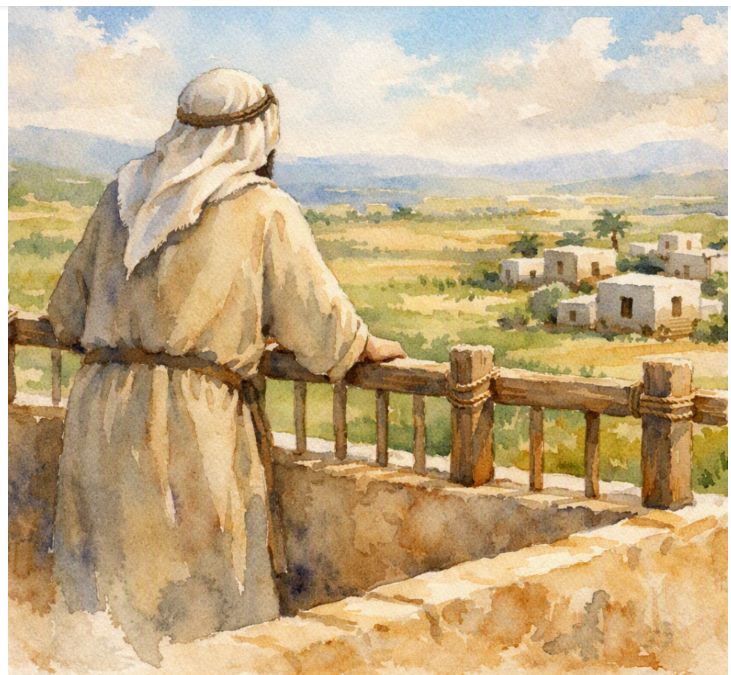
“If you build a new house you should make a guardrail for your roof, in order that you not bring blood upon your house if a fallen one falls from it.”[1] This commandment in parashat Ki Teitzei seems fairly straightforward, as it joins a long list of commandments designed to ensure that property owners take all the necessary precautions to ensure that they are not responsible for injuring others. Since an open roof is a serious safety hazard, the Torah instructs the builder to construct a protective railing around it, so that no one falls off the roof. Obviously, there are also more dimensions to this commandment that touch upon deeper issues in our lives. Let us look at these.
Parashat Ki Teitzei is always read in the month of Elul to provide us with an important personal message. As we prepare for the New Year and strive to attain a higher level of consciousness, we are in effect figuratively building a new house and, as it were, climbing to its roof. Many of us find this experience—the month of Elul and the Holy Days of Rosh HaShanah and Yom Kippur—to be a dizzying one. To help us reign in our expectations, which can sometimes be likened to building castles in the air, so to speak, the Torah teaches us to make a fence around our new aspirations by protecting the roof, the new level of consciousness. Furthermore, we must create a disciplined plan of action to put our New Year’s resolutions into effect and not squander our newly found, highly elevated ideals.
Similar to all commandments in the Torah, Chasidut teaches us to seek out deeper personal and spiritual meanings. By “going up to the roof” one gains new horizons, which can lead to new perspectives, unhampered by our current perspective on life and what are most likely its inherent limitations.
Falling From the Roof
Based on the unusual formulation of the verse—“if a fallen one falls from it,” instead of “if someone falls from it”—Rashi comments that if someone falls off a roof, it is because he or she was already “a fallen one.” For some reason, they were already deserving or destined to fall from a roof.[2] The message that the verse is teaching us is to be careful that this individual does not fall from our roofs. Since, as Rashi continues, good things occur through the agency of good people and bad things come to pass through the agency of bad people, we must be careful not to let our negligence make us culpable. This is the clear reading of the verse’s plain meaning.
The inner dimension takes us deeper. Based on the Torah’s inner dimension, the interpretation becomes that we must realize that when we “go up to the roof,” when we go through the intensely spiritual high of the month of Elul and the High Holy Days and climb to a higher spiritual state, we should know that this state is transitional. Ultimately, when the excitement is over, we will have to come down into the hum and drum of daily life and will fall from whatever new and elevated consciousness we have reached.[3] The descent is unavoidable, just as the law of gravity is built into the physical nature of the world. Ascent followed by descent is built into our human psychological makeup. In Chasidut, these two states are known as “expanded mindedness” (גַּדְלוּת מוֹחִין) and “contracted mindedness” (קַטְנוּת מוֹחִין). King David is a prime example of someone who was accustomed to going up to the roof to commune with God. Ultimately, King David “fell” because he was on the roof, as the prophet relates,
And it came to pass that one evening David arose from his bed and walked upon the roof of the king’s house, and he saw a woman bathing on the roof, and the woman was exceedingly beautiful.[4]
Thus begins the saga of David and Bathsheba, an episode that haunted David for the rest of his life.
Orchestrating One’s Own Fall
If the fall is inevitable then perhaps it would be better (metaphorically speaking) to never go up to the roof, to never attempt to go beyond one’s comfort zone. Chasidut claims otherwise and cites the commandment to build a guardrail as proof. The Torah does not advise people to forego building new houses or to forego going up to the roof; rather, it advises them to build guardrails to prevent people from falling off their roofs.
Yet a question remains: how does a guardrail help if it is inevitable that we fall? The guardrail spiritually symbolizes our orchestrating our own fall! How so? By adopting an attitude of lowliness and humility at the very moment that we experience the climactic peak of “being on the roof,” we are able to control the fall.[5] If we maintain true humility then our fall becomes purposeful and directed. True humility acts like a counterweight that balances the new heights of consciousness achieved in “the run” of the soul. We only truly fall when we have no fence, no guard against the undue pride or self-aggrandizement we experience when the actual experience of elevation overly inflates our egos. Thus, we must realize that in the act of elevation, the soul undergoes a dual movement directed both above (going up to the roof) and below (in the orchestrated, but inevitable, fall of humility). In doing so, the soul fulfills the Divine dynamic within it, which serves as its pulse of spiritual life, and is known as “run and return.”
King David – The Fallen One
King David, and by inference the Mashiach, his descendant, is referred to in the Talmud as a miscarriage or, more literally, as a “fallen one” (bar nafla).[6] The Zohar explains that David’s soul had not been apportioned time in this world.[7] When Adam prophetically foresaw this predicament, he gave David 70 years of his own life. David in fact lived seventy years and Adam, who was supposed to live a thousand years, lived only 930 years. Chasidut explains that David was constantly aware of this gift, and of how tenuous his soul’s grasp on life was.[8] This sensitivity gave David both an unprecedented ability to praise God for every breath of life, as well as a haunting ability to grasp the existentially precarious nature of the soul’s presence in this transient world. David felt as if he was constantly being born, as he says, “God said to me: ‘You are my son, today I have given birth to you.’”[9]
A Deeper Dimension
Since Rosh HaShanah according to Jewish tradition corresponds to the sixth day of creation, the day that humanity was created, the first day of Creation corresponds to the 25th day of Elul.[10] There is a Kabbalistic tradition from Rabbi Shalom Sharabi, based on earlier teachings of the Arizal, in which he explains that the World of Chaos (Olam HaTohu), which precedes this current world called the World of Rectification (Olam HaTikun), can be envisioned to parallel the 7 days that precede the 25th of Elul, i.e., the week from the 18th through the 24th of Elul.[11]
He further taught that spiritual worlds even before Olam HaTohu can be envisioned as paralleling the days that precede the 18th of Elul.[12] This strengthens the idea that the month of Elul is directly engaged with the creative process of constructing worlds or realities, including our own, which we will humbly inhabit on the sixth day of creation, Rosh HaShanah. From this perspective, Rosh HaShanah can then be understood as the day we move into the new house that we build during the month of Elul.
The Arizal explains that our present reality is called Olam HaTikun for it is made up of the previous world’s broken vessels, which require our healing intervention to be rectified and brought back to wholeness. These immature vessels, the sefirot of that world, were not strong or flexible enough to contain the primordial light flowing into them during the initial act of creation, so they shattered in a cataclysmic event known as the “Shattering of the Vessels.” Humanity, especially the Jewish people are charged with gathering these scattered sparks and redeeming the light contained within the broken vessels.
According to tradition, King David had relations with Bathsheba on the 24th of Elul, which corresponds to the last day of the breaking of the vessels in Olam HaTohu.[13] He then desperately tried to cover up his behavior. When the prophet Nathan visits David and through telling him a parable, David realizes the wrong he has done, it is without hesitation that he declares, “I have sinned!”[14] He then spent the rest of his life in a constant state of repentance, as any sensitive reader of Psalms can attest.
Even though the Sages explain that technically David was not guilty of either adultery or murder,[15] his exact sin is still open to debate. Moreover, David himself certainly felt he had done something wrong, and therefore spent his entire life repenting for it. Either way, in an attempt to explain how David could have acted as he did, the Sages explain that these actions were so out of character for David that on some level these events only came to pass “in order to teach the individual how to do teshuvah.”[16] In other words, as many commentaries explain, in some mysterious way God “arranged” the entire incident, not only to provide David with a test that could lead to his spiritual development, but, should he fail (as he seems to have), to provide a model for others instructing them on how to repent and return to God’s good graces following a “fall from the roof,” so to speak.
The Bridge of Teshuvah
The idea of God orchestrating the entire incident of David and Batsheba is in line with the teaching that the “breaking of the vessels” should not be seen as a “mistake” in God’s creative process, but rather a critical ingredient in the formation of the World of Rectification. Based on this, we can now understand better why teshuvah is considered to have been created even before this world, the World of Rectification.[17] David embodies and bridges the chaotic climax of the final day of the breaking of the vessels, the 24th of Elul, with the healing intention and introduction of teshuvah even before the onset of the 25th of Elul and the Creation of our present reality. Teshuvah, a return to God based on recognition of one’s sins, is thus the foundation upon which the current World of Rectification is constructed.
Since the incident of David and Batsheba occurred on the last day of the breaking of the vessels in Olam HaTohu it is associated with the final sefirah of kingdom (malchut), kingdom. King David is considered the archetypal soul of the sefirah of kingdom. His whole life, from beginning to end, consisted of extreme challenges and heroic attempts to rectify his own shortcomings, while simultaneously leading Israel as king and uniting the tribes as never before. Thus, his life and his legacy, as chronicled in the Book of Samuel and his Book of Psalms, attest to the profound power of teshuvah. They also provide a blueprint for the creative dynamics that exist between the worlds of Tohu and Tikun. King David therefore paved the path of teshuvuah and serves as the channel for each individual to access and animate God’s compassion through the primordial energy of teshuvah.
Kabbalah explains that the lowest sefirah, kingdom (malchut) in one world or level of consciousness descends to become the highest sefirah, the crown (keter) in the world below (or following) it. Thus, the last level of the World of Tohu (the 24th of Elul) itself becomes the first level in the World of Tikun (the 25th of Elul), illuminating the interdependence that exists between the cosmic processes of both breaking and repair. The narrow bridge between these two worlds, and the method through which the ultimate fixing may be accomplished on a personal, national and ultimately universal level, is the teshuvah that we speak about so much during these final days of the year.
[1]. Deuteronomy 22:8.
[2]. Ibid.
[3]. Melech BeYofyo, pp. 245-248.
[4]. 2 Samuel 11:2.
[5]. Melech BeYofyo, loc. cit.
[6]. Sanhedrin 96b.
[7]. 1:168a.
[8]. See also Derech Mitzvotecha, Minuy Melech, ch. 2 for a deeper explanation of this midrash.
[9]. Psalms 2:7.
[10]. Vayikra Rabbah 29:1; also Pirkei DeRabbi Eliezer 8:1.
[11]. Mivchar Shiurei Hitbonenut, vol. 9, p.202.
[12]. Ibid., p. 197.
[13]. Ibid.
[14]. 2 Samuel 12:13.
[15]. Shabbat 56a. The murder referred to is the death of Batsheba’s first husband in battle.
[16]. Avodah Zarah 4b.
[17]. Pesachim 54a.

