


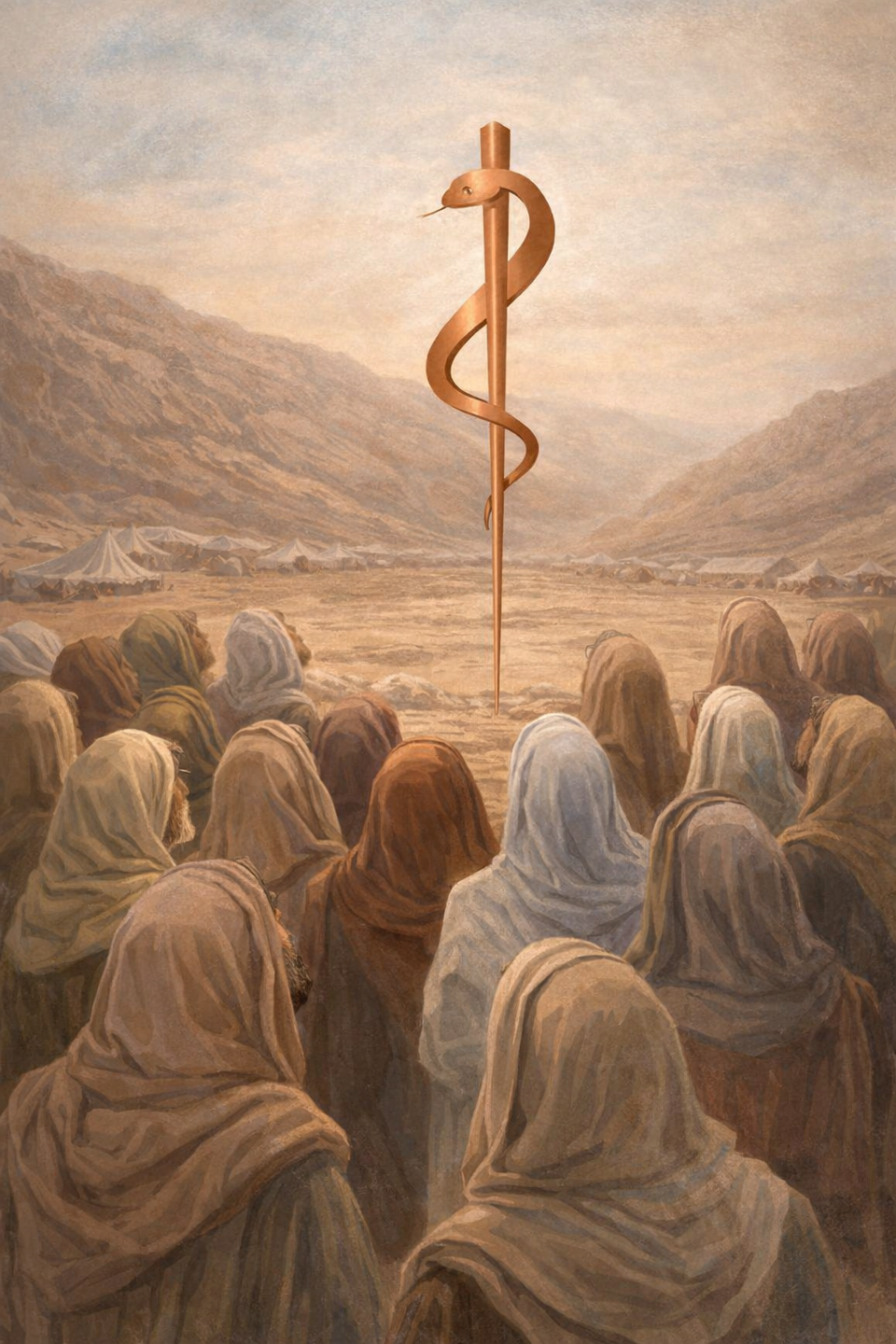
Parashat Chukat includes the story of the serpents and the copper snake made by Moses to heal those who had been bitten by them. This episode is considered a primary source for the healing principle of “like cures like” and for the general stance we should take for rectifying evil by elevating it to its source.
This is an abridged version of a Hebrew recording from Rav Ginsburgh from the early days of Corona, the 29th of Adar, 5780. It was first published in the Chukat 5780 issue of Niflaot.
All Is Good
One of the basic tents appearing in the Tanya is that the root of the evil we experience in our lives is in truth the very highest good, but it is a good that cannot be grasped. The Alter Rebbe writes[1]:
When a person contemplates deeply and pictures in his mind his coming into being ex nihilo [from nothingness] at every single moment, how could it enter his mind that there is evil for him, or any suffering regarding children, life, or sustenance, or any other worldly sufferings? For the Ayin, which is God’s wisdom is the source of life, goodness, and delight. It is the Eden that transcends the World to Come. Only because it is not grasped does it appear to him as evil or suffering. But in truth no evil descends from above, and everything is good—only it is not grasped [as such] due to the immense abundance of His goodness… And he shall believe that in truth [a life dedicated to mitzvot] gives life, and all his needs and all his affairs unfold in truth in their finest details, not from the “other side” [evil], for “from God are a man’s steps established… and if so, everything is absolutely good, only it is not grasped [as such by man]…
Before we begin looking at the connection between this epistle and the Copper Serpent Moses made to heal, let us note a few gematriot. The phrase, “everything is good” (הַכֹּל טוֹב) recurs several times in the epistle and its value is 72, the same as “loving-kindness” (חֶסֶד), “The world was built with loving-kindness”[2] (עוֹלַם חֶסֶד יִבָּנֶה). The value of the longer phrase, which summarizes the entire epistle, “all is absolutely good, only it is not grasped” (הַכֹּל טוֹב בְּתַכְלִית רַק שֶׁאֵינוֹ מוּשָּׂג) is 1950, the product of 26—the gematria of God’s essential Name, Havayah, the Name of Divine compassion—and 75—the gematria of “trust” (בִּטָּחוֹן), i.e., “Trust in Havayah.”
"Nachash Nechoshet" — The Beginning of Creation
Commentaries on this epistle, connect it with what the Alter Rebbe wrote on the Copper Serpent in our parashah:
… the people became disheartened because of the journey. The people spoke against God and against Moses; [They said:] “Why have you brought us up out of Egypt to die in this desert, for there is no bread and no water, and we are weary of this light bread [manna]. God sent the venomous snakes against the people, and they bit the people, and many Israelites died. The people came to Moses and said, “We have sinned, for we have spoken against God and against you. Pray to God that He remove the snakes from us.” Moses prayed on behalf of the people.
God said to Moses, “Make for yourself a viper and put it on a pole, and let whoever was bitten look at it and they will live.” Moses made a copper snake and put it on a pole. If a snake had bitten a person and he looked toward the copper snake, he lived.[3]
Clearly, the episode of the Copper Serpent is the primary Torah source for the Alter Rebbe’s tenet that the root of apparent evil—the image of the snake itself—is in truth the absolute good.
Sweetening Evil at Its Root
What is the secret of the Copper Serpent? How is it that the snake is what kills and it is the image of the snake that heals? The commentators on the 11th epistle in the Tanya refer to the Alter Rebbe's discourse. We shall summarize his words. The Alter Rebbe opens with a question. The Mishnah states that it was not gazing at the Copper Serpent that healed the person, rather, “When Israel looks upward and subjugates their hearts to their Father in Heaven, they would be healed.”[4] If so,
Why was the serpent needed at all? Let it simply say: “If the serpent bit a man, he shall look upward.” And furthermore: what is the meaning of “looking upward"? For it is explained regarding prayer that one's eyes should be downward while one's heart is upward.
To answer, the Alter Rebbe explains that the ultimate purpose of the soul’s descent into the body is to transform the bitter experiences of life into sweetness. Before the soul descends it is attached to God through love and awe at a higher level, unimpeded by the body, but once the soul descends, its task is to contemplate during prayer that all evil, including one’s own evil inclination and all the harsh judgments and bitter sufferings that stem from it, have a good root. The Alter Rebbe writes,[5]
The matter is that judgments are sweetened at their root. For all evils and harsh judgments that came into existence in the world — their root and source, which gives them life, is good… but when it descends below through the process of chaining down, it becomes truly evil and truly harsh judgments, both in worldly matters and in heavenly matters. When a person experiences some suffering, he should think: I should not judge that something is evil merely by appearances; in truth its root is good….
This is what is meant by “[You shall love God] with all your might.” The word “might” [literally “very”] here refers as to the teaching that the Angel of Death [the evil inclination] is called “very”: “good” refers to the Angel of Life; “very good” refers to the Angel of Death,[6] for it is exceedingly and boundlessly good, only it has not yet come to revelation and is not grasped…
The Alter Rebbe elaborates at length that this contemplation is the ultimate purpose of the work of prayer, which demands ever greater length and effort from generation to generation, and he explains that when one looks toward the root of reality during prayer, one can actually change reality for the better. He concludes:
This is the matter involved in the Copper Serpent. It had to be placed upon a pole, for it required the elevation of the serpent on high—back to its source. And then when someone gazed upon it, they would have to look upward. In other words, by looking up to the root, one would no longer think of the serpent as separate from its Divine root, because when it is separate, it is truly evil and remains evil. But when one thinks of the serpent in its sublime form above, at its root where it is not separate from God, the source of its vitality… then no evil descends from Above.
Additionally, it was made of copper, because copper changes to many hues, through the Divine Ayin….
The Copper Serpent and Genesis
Let us analyze the story of the Copper Serpent a bit more. In it, the root “serpent” (or “snake”) appears a total of seven times—five times as נָחָשׁ (snake) and twice as נְחֹשֶׁת (copper). The numbers 5 and 2 are the “golden section” of 7 (as explained elsewhere, the Hebrew word for “gold” is זָהָב, whose letters equal 7, 5, and 2, where 5 and 2 as noted are the golden section of 7).
The Copper Serpent is a primary example in the Torah of wordplay through phonetic similarity (לָשׁוֹן נוֹפֵל עַל לָשׁוֹן). Rashi writes[7]:
“A copper snake”: He [Moses] was not told to make it of copper, but Moses said: the Holy Blessed One calls it a “nachash” [a snake], so I will make it of nechoshet (copper), wordplay through phonetic similarity [lashon nofel al lashon].
There is only one other place where Rashi explicitly notes that someone used this same principle of wordplay through phonetic similarity. There it on the verse, “This one will be called a woman, for she was taken from a man”[8] (לְזֹאת יִקָּרֵא אִשָּׁה כִּי מֵאִישׁ לֻקְחָה זֹּאת). From here, Rashi states, we learn that the world was created in the holy language, Hebrew. These are the two primary examples of this linguistic principle in the Torah—man-woman and nachash-nechoshet. Just as man-woman are a male-female pair, so are nakhash and nechoshet. Clearly, the male is the snake (nakhash) and the female is the copper (nekhoshet). We thus see a connection between the act of Creation—in which God creates the world in Hebrew, the holy language, and therefore Moses understands on his own, by his own reasoning, that the snake he is putting on a pole should be made of copper.
This connection is also seen numerically: it is well known that “snake” (נָחָשׁ) has the same gematria as Mashiach (מָשִׁיחַ). Copper (נְחֹשֶׁת) is Mashiach with a tav (ת) appended. Esau had four hundred (ת) men; they later merited to be reincarnated as the four hundred men that followed David when he was wanted by Saul; ultimately they will reincarnate as the four hundred men of Mashiach. The full phrase, “copper snake” (נְחַשׁ נְחֹשֶׁת) equals 1116, the same as the Torah’s first two words, “In the beginning… created” (בְּרֵאשִׁית בָּרָא). Thus, the very first thing God creates is the copper serpent, meaning that the beginning of all our contemplation and prayer should be to focus on the root-goodness of all things, which appears with the very beginning of God's creation.
The Remedy: Knowing the Root of the Illness
All of this is the secret of the Copper Serpent. The serpent is the most evil image that exists. It brought death into the world. And yet, when I make from it a copper snake, suddenly it becomes the very source of healing. The Alter Rebbe’s point in epistle 11 is that apparent evil—what appears as evil—is in truth the highest good. In Aramaic, “evil” (רַע) means “sick,” so this entire matter is particularly relevant to the subject of illness and healing.
There is a saying that, “knowing the illness is half the remedy.” We can now explain that the true knowledge of the illness is not merely knowing that you are ill, nor just knowing what illness you have, but knowing that the root of the illness is good, only it is not grasped.
Like Cures Like
We like to explain that the Torah’s first two words, “In the beginning [God] created,” mean “In the beginning… healthy” (בְּרֵאשִׁית בָּרָא—בְּרֵאשִׁית בָּרִיא). To serve God, to fulfill the Torah and its commandments, one must be healthy, strong, and joyful. Moses took all these concepts together and made the snake from copper. He utilized the principle that “from itself, the axe that cuts the tree is made,” otherwise known as “like cures like.” Curing like with like requires seeing that the cure is within the disease itself—that the inner dimension of evil is the very essence of good, the highest good. This is also the secret of the wordplay based on phonetic similarity we saw above.
[1]. Tanya, epistle 11.
[2]. Psalms 89:3.
[3]. Numbers 21:4-8.
[4]. Rosh HaShanah ch. 3, end of.
[5]. Likkutei Torah, Chukat 64a and ff. S.v. “Vaya’as Moshe Nakhash Nekhoshet.”
[6]. Midrash Bereishit Rabbah 9:7.
[7]. On Numbers 21:9.
[8]. Genesis 2:23.

