


Every week this year, Wonders Magazine has been hosting a special article from our guest editor, Rabbi Arieh Trugman, who is one of HaRav Ginsburgh’s most longstanding and dedicated students. Rabbi Trugman is the author of dozens of books mostly based on the teachings of HaRav Ginsburgh.
Thanks to his lucid and easy style, his articles have helped many around the world better understand the depth of Kabbalah and Chasidut as taught by HaRav Ginsburgh.
Birkat Kohanim, the Priestly Blessing, appears in parashat Naso in the Book of Numbers.[1] It contains 15 words and 60 letters: “May God bless you and watch over you. May God cause His countenance to shine on you and favor you. May God raise His countenance toward you and grant you peace.”
יברכך י־הוה וישמרך
יאר י־הוה פניו אליך ויחנך
ישא י־הוה פניו אליך וישם לך שלום
Rashi informs us that although Birkat Kohanim only appears in Naso, it was first used in the portion of Shemini when Aharon blessed the people on the day the Tabernacle was consecrated.[2]
This blessing was uttered in the Tabernacle in the desert and later in the Temple in Jerusalem. When blessing the people, the Kohanim pronounced God’s essential four-letter Name, as it is written, adding to its awesome holiness. This was an exception for this unique spiritual experience. After the destruction of the Temple, the sages incorporated the Priestly Blessing into the synagogue prayer service, albeit without pronouncing God’s Name as written. This is one of numerous ways the sages transformed facets of the Temple service and their deeper meanings into the new synagogue setting. The Priestly Blessing is used at other times as well, especially by parents when blessing their children on Shabbat eve.
The first word of the Priestly Blessing in Hebrew is “May [God] bless you” (יברכך) and the last word is “peace” (שלום). This phenomenon prompted the sages to end the entire corpus of the Mishnah with the words, “there is no vessel that contains blessings as well as peace.”[3] Likewise, this prompted the sages to end the last blessing of the Amidah—the quintessential Jewish prayer recited three times daily—with the word “peace.” An even more emphatic statement of the centrality of peace appears in the Talmud,[4] which states, “The entire Torah was given with for no other purpose than to make peace in the world, as it is written: ‘Her [the Torah’s] ways are ways of pleasantness and all her paths are of peace.’”[5]
The Hands of the Kohanim
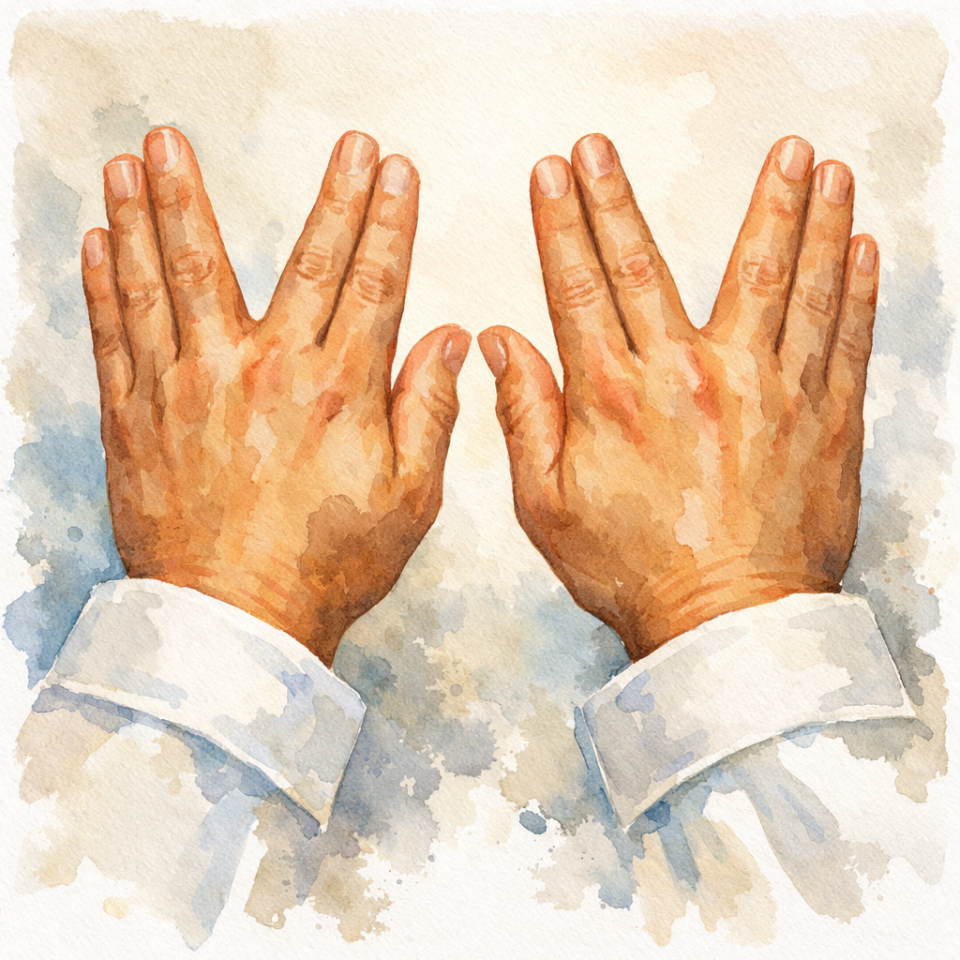
When the kohanim bless the people, they raise their hands before them as if the blessing is being channeled through their hands directly to the people. This is learned from the verse in Shemini: “Aaron raised his hands towards the people and blessed them…”[6]
The Mishnah states that there are 30 bones in each hand.[7] Therefore, both hands have 60 bones, the same number as letters in Birkat Kohanim. Additionally, there are three joints in each of four fingers and two joints in the thumb, all of which are attached to the palm of the hand. Altogether, there are 15 joints in the hand, the same number of words in Birkat Kohanim. These numerical insights relate to the hands as channels through which blessings are bestowed.[8]
Just as the ten sefirot are the conduit through which the infinite Creator channels Divine energy and light into progressive levels of finite reality, the ten fingers of the kohanim direct God’s grace and light to the people of Israel. Tradition teaches that at the time the kohanim are blessing, one should not look directly at them, especially at their hands spread out, as at that moment the powerful Presence of the Shechinah is manifest. For the same reason, we are taught not to stare for a prolonged time at a rainbow due to the intense Presence of the Shechinah.[9]
Divine Grace and Symmetry
Birkat Kohanim is an expression of the bestowing of Divine grace on the People of Israel. The three verses of Birkat Kohanim can be arranged in the symmetrical form of a triangle whether we look at the number of letters in each verse or the number of words in each verse. In terms of letters, there are 15, 20, and 25 letters, and in terms of the words there are 3, 5, and 7.[10]
This is only one of the many examples of symmetry in the Priestly Blessing. Another is that the middle of the 15 words, i.e., the eighth word, is “He shall grant you grace” (ויחנך). The root of this word, chen, means “grace,” and is interpreted in Kabbalah to represent a particular type of beauty manifested in a state of symmetry.[11]
It is important to note that the relationship between 15 and 60, the words and letters of Birkat Kohanim, is associated with the letter samech which is the 15th letter and whose numerical value is 60.[12] The samech is shaped like a circle (ס) and thus represents a circular flow, in this case between the kohanim and the people. The hands, with 15 joints (in each hand) and 60 bones (in both hands), are the conduit through which the Divine light and grace are channeled to the people.
Soul and World Elevations
To better understand one of the deepest secrets of Birkat Kohanim, we will first introduce a number of important concepts of Kabbalah and only then relate them directly to this very special blessing.[13]
One of the deepest concepts revealed by the Arizal is that the five times the word “light” is mentioned on the first day of Creation alludes to both the Five Books of Moses and to the five levels of soul: 1. Nefesh, the animal soul most connected to the body; 2. Ru’ach, relating to the emotions; 3. Neshamah, corresponding to the intellect; 4. Chayah, the bridge between the conscious and the superconscious, and 5. Yechidah, the source of the soul in Divinity.
The Arizal explains that the first two levels of soul—nefesh and ru’ach—are given to each person, (though they need to be clarified and refined) but the three higher levels of soul—neshamah, chayah, and yechidah—have to be “earned” through each person’s own spiritual work. He finds an allusion to this in the fact that the Torah uses the word “light” twice when describing light’s creation and then another three times on the first day of Creation.
This notion that each person must work to attain three additional levels of soul is related to the tradition that on Shabbat, Jews receive an additional level of soul known as the neshamah yeteirah. This soul level represents the elevated feelings a Jew can experience when tapping into the increased sense of spirituality available on Shabbat. Furthermore, Shabbat’s three festive meals, which correspond to Shabbat’s three time periods—evening, morning, and afternoon—afford a weekly opportunity to reach beyond the mundane and taste the three higher levels of soul.
Another teaching that parallels the soul’s need to elevate to these three levels, appears in the Arizal’s profound mystical cosmology. According to the Arizal, there are five “worlds.” Arranged from the highest to the lowest, they are: 1. Adam Kadmon (Primordial Adam), 2. Atzilut (Emanation), 3. Beriah (Creation), 4. Yetzirah (Formation), and 5. Asiyah (Action)—the physical, material world we live in. Incidentally, these five worlds are also hinted to by the five appearances of the word “light” on the first day of Creation. The Shattering of the Vessels in the World of Chaos which preceded our own, occurred in the “space” that would later be occupied by the World of Emanation. This cosmic calamity caused the three lower worlds of Beriah, Yetzirah, and Asiyah to come into being, and reality is considered to have therefore “fallen” three levels, each succeeding world representing a more condensed material manifestation of God’s pure light. Thus, for any particular state of reality in any one of the worlds to reach its true source, it must ascend three levels.
We will now add another teaching of the Arizal regarding reincarnation, which connects to the above ideas. The opening sections of the Gate of Reincarnations (Sha’ar HaGilgulim), the Arizal’s revelations regarding reincarnation, deal primarily with an explanation of the five levels of soul discussed above.
The Arizal explains that a soul, to complete itself, must perfect all five levels. One does not receive the next level of soul in the fullest sense until he or she perfects the preceding level. As may be imagined, this process can take many lifetimes. Once each level of soul reaches a rectified state, it can receive the next level. This continues until all levels of soul are complete. In simpler terms, the Arizal was teaching that for a soul to reach completion, it must clarify and rectify its instinctual, emotional and intellectual levels of consciousness, along with its higher levels of innate spiritual and Divine consciousness.
Along with completing the five levels of soul, the Arizal taught that these levels must also ascend through all the worlds. These five worlds correspond directly to the five levels of soul in the following manner:
Adam Kadmon – Primordial Man – Yechidah – unique Divine soul
Azilut – Emanation – Chayah – living one; superconscious will
Briah – Creation – Neshamah – intellectual
Yetzirah – Formation – Ruach – spirit; emotional
Asiyah – Action – Nefesh – psyche; instinctual, behavioristic
Each level of soul actually contains all five levels, as explained in the Kabbalistic principle of inter-inclusion. Therefore, in each world there are 25 levels. To reach its complete fulfillment, each soul must rectify all 25 levels in each of the five worlds. The sum total levels of rectification needed is thus 125 levels.
Since the Arizal taught that each person is given the first two levels of soul—nefesh and ru’ach—but must earn the higher three levels of neshamah, chayah and yechidah, this implies 75 levels of soul that need to be attained. This is not to say that the first two levels of soul do not need refinement and rectification, they most certainly do. But these rectifications are somewhat easier to accomplish.
Returning to Birkat Kohanim
We will now connect these profound ideas to Birkat Kohanim.[14] The numerical value of the word kohen (כהן) is 75. It is through the kohanim that the blessing is channeled from God to the People of Israel. Seventy-five is the number of rectifications needed to acquire the three higher levels of soul. It should also be noted that Birkat Kohanim consists of 75 letters and words: 15 words and 60 letters. Thus, each of the blessings represents one of the three ascending levels of soul the person is attempting to acquire, as well as one of the three higher worlds. The correspondence is therefore:
“May God bless you and watch over you”—the neshamah and the World of Creation.
“May God cause His countenance to shine to you and favor you”—the chayah and the World of Emanation.
“May God raise His countenance toward you and grant you peace”—the yechidah and the World of Primordial Adam.
The idea of elevating oneself to an additional three levels of soul and elevating the worlds, which fell three levels at the breaking of the vessels, is intrinsically connected to the mission of the Jewish people who were told by God that we are to be “a nation of kohanim and a holy people.”[15] Similar to how the kohen has a special status in Israel, so too, the Jewish people are meant to serve, teach, inspire and bring light to the entire world. As the kohanim channel God’s light and blessing to the Jewish people in Birkat Kohanim, the Jewish people as a whole are meant to spread God’s light and blessing to all peoples.
It goes without saying that the more one understands the various levels of soul and the various spiritual worlds, the more profound an effect contemplating these connections in relation to Birkat Kohanim will have. Even without understanding all of the nuances of these connections, simply contemplating the literal meaning of the words of Birkat Kohanim, and allowing oneself to become a vessel to receive these powerful blessings from Above, has the potential power to open up the soul to receive an influx of Divine bounty that uplifts and infuses the soul with spiritual light.
[1]. Numbers 6:24-26.
[2]. Leviticus 9:22
[3]. Uktzin 3:12.
[4]. Gittin 59b.
[5]. Proverbs 3:17.
[6]. Leviticus 9:22.
[7]. Ohalot 1:8.
[8]. For further insights regarding the 30 bones in each hand see Yaiyn Yitzchak, Naso.
[9]. Chagigah 16a.
[10]. The Hebrew Letters, p. 235
[11]. See in length in our book, Dancing Flames.
[12]. The Hebrew Letters, loc. cit.
[13]. The rest of this article is based on Chasdei David HaNemanim, Chelek 4, pp. 84-122.
[14]. Ibid, pp. 84-88.
[15]. Exodus 19:6.

