


Rabbi Meir was among the most prominent sages of the Mishnah and one of the founders of the Sanhedrin in Usha. He was born to a family descended from Emperor Nero, who had converted to Judaism. He married Beruriah, daughter of Rabbi Chanina ben Teradion, who was renowned for her wisdom. In his youth, he studied under Rabbi Yishmael but received the essence of his learning approach from Rabbi Akiva. He is one of Rabbi Akiva’s five disciples "from whom Torah went forth to the world." He also received Torah from Elisha ben Avuyah, from whom he continued learning Torah even after he deserted Judaism and joined the Romans. To explain his continuing relationship with Elisha, the sages said: "Rabbi Meir found a pomegranate; he ate its contents and discarded its peel." He was ordained by Rabbi Yehudah ben Bava with self-sacrifice, and among his students were: Rabbi Yehudah HaNassi, Sumchos (Symmachus) ben Joseph, Rabbi Chanan, Rabbi Yaakov, and others. Rabbi Meir served as a scribe of sacred texts and was also known as a great preacher. The rabbis said, "When Rabbi Meir died, there no more masters of parables." The concise language of his teachings was chosen by Rabbi Yehudah HaNassi to serve as the foundation for the Mishnah, and he was renowned for his profound wisdom: "His colleagues could not fathom the depth of his understanding." His date of passing is observed on the 14th of Iyar.
When Rabbi Chanina ben Teradion, one of the Ten Martyrs executed by the Romans, was put to death, the Romans decreed that his wife should be executed and his daughter was sentenced to sit in a brothel. His second daughter, Beruriah, the wife of Rabbi Meir, came before Rabbi Meir regarding her sister’s situation and asked that he go and free her.
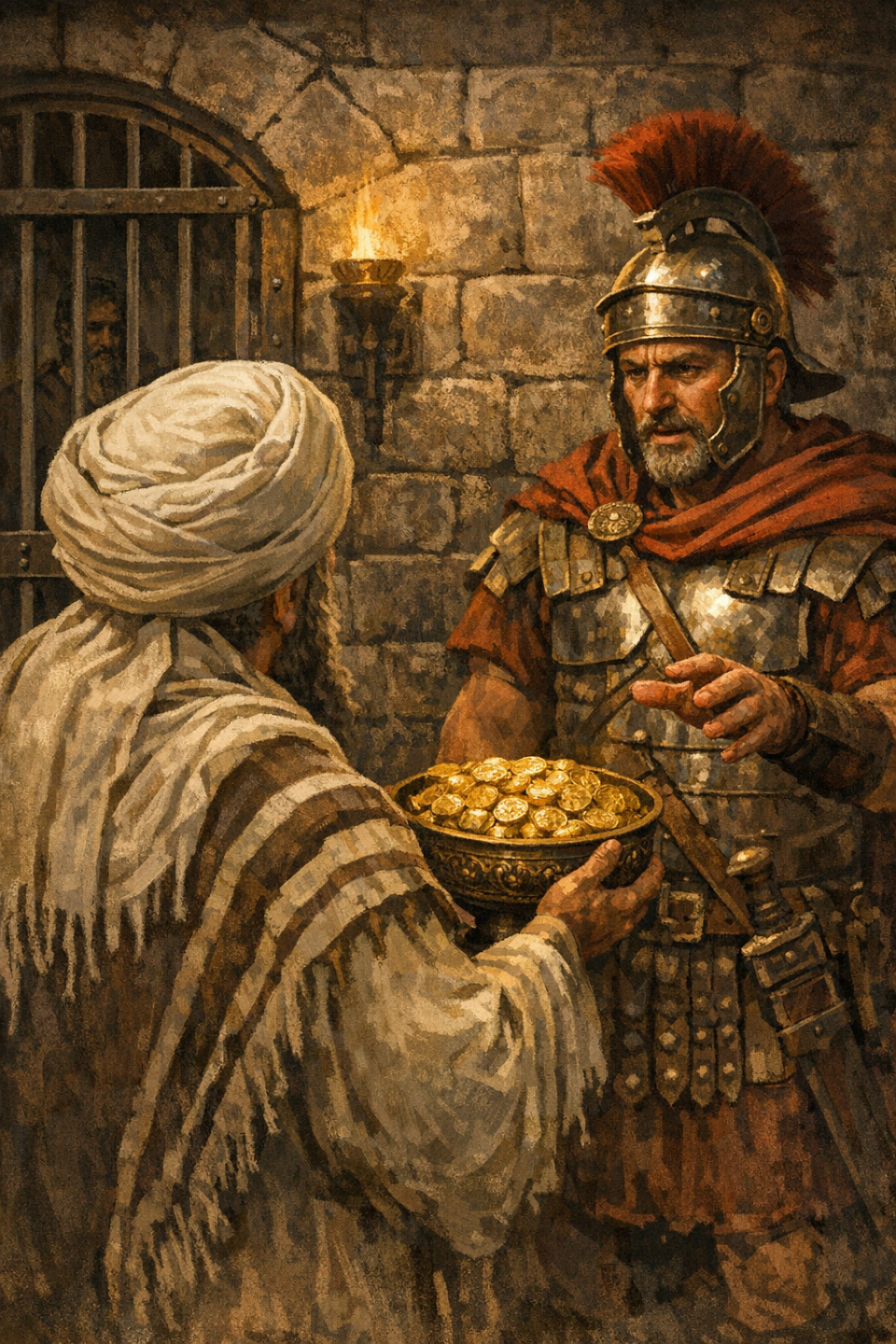
Rabbi Meir took a large vessel full of dinars and went to the place where she was. Before approaching to save her, he said to himself: If no transgression was committed with her, a miracle will be performed for her; if she committed a transgression, no miracle will be performed for her.
Rabbi Meir went and dressed as a Roman knight, and said to her: Accede to my wishes, i.e., engage in intercourse with me. She said to him: I am menstruating and cannot. He said to her: I will wait. She said to him: There are many women in the brothel, and there are many women here who are more beautiful than I. He said to himself: I can conclude from her responses that she did not commit a transgression, as she presumably said this to all who come.
Rabbi Meir went over to her guard and said to him: Give her to me. The guard said to him: I fear that if I do so, I will be punished by the government. Rabbi Meir said to him: Take this vessel full of dinars; give half to the government as a bribe, and half will be for you. The guard said to him: But when the money is finished, what shall I do? Rabbi Meir said to him: Say: God of Meir answer me! And you will be saved. The guard said to him: And who can say that this is the case, that I will be saved by this utterance? Rabbi Meir said to him: You will now see. There were these carnivorous dogs that would devour people; Rabbi Meir took a clod of earth, threw it at them, and when they came to devour him, he said: God of Meir answer me! The dogs then left him alone, and after seeing this the guard gave the daughter of Rabbi Chanina ben Teradyon to Rabbi Meir.
After some time, the matter became known to the government, and they sought to hang the guard. He said: God of Meir, answer me! and their attempt to hang him failed. They brought him down from the gallows and asked him: What is this all about? The guard told them the entire story, and they hung Rabbi Meir's portrait at the gates of Rome so they could bring him to trial, and they said: Anyone who sees a man with this face should bring him here.
One day, Romans saw Rabbi Meir and ran after him, and he ran away from them and entered a brothel to hide. Some say he then escaped capture because he saw food cooked by gentiles and dipped his finger in the food and tasted it with that other finger, and thereby fooled them into thinking that he was eating their food, which they knew Rabbi Meir would not do. The Romans who were chasing him said: Heaven forbid, if this were Rabbi Meir, he would not act in that manner.
Rabbi Meir arose, fled, and arrived in Babylonia.
(Avodah Zarah 18a)
The wondrous power of salvation that Rabbi Meir possesses, which is revealed in this prayer, is particularly connected to Pesach Sheni, the Second Passover, celebrated on the 14th of Iyar. This is the day on which those who were not ritually pure and could not bring the Pesach offering on time are given a second chance to fulfill their obligation. This is also the day traditionally identified as the yahrzeit (day of passing) of Rabbi Meir.
The essence of Second Pesach is that there is no lost cause and all who are impure can be purified and bring the Pesach offering even though its allotted time (the 14th day of Nissan) has passed. Similarly, Rabbi Meir and his prayer are especially capable of extracting people from seemingly hopeless situations. What is Rabbi Meir’s secret?
When contemplating the figure of Rabbi Meir, the figure of his wife, Beruriah, stands out prominently. In most places that Beruriah is mentioned, her name is spelled with an alef at the end (בְּרוּרְיָא). Her name, spelled with a hei at the end (בְּרוּרְיָה), appears only three times corresponding to the three intellectual sefirot—the mochin—while Beruriah with an alef at the end appears seven times—corresponding to the seven emotive sefirot. The last appearance of Bruriah with an alef is in the title, “Beruria the Queen” (בְּרוּרְיָה הַמַּלְכָּה) who converted, alluding to the sefirah of kingdom. What does she reveal to us about the character of Rabbi Meir?
One of the well-known stories about Beruriah tells of Rabbi Meir’s wicked neighbors, who caused him great distress. Rabbi Meir wanted to pray that they should die, but his wife Beruriah told him that it was not proper to do so for the verse reads, “May sins cease from the earth,” the sins should be eradicated but not the sinners, she argued. Instead, pray for them to repent and let their sins cease, and it will follow that “the wicked will be no more.” Rabbi Meir accepted Beruriah’s words, prayed, and his neighbors repented.
Regardless, They Are Called God’s Children
What made Beruriah interpret the verse ““May sins cease from the earth and the wicked will be no more,” the way she did? We might say that besides the logic of her argument in and of itself, Beruriah recognized that this was the interpretation that was the best fit for Rabbi Meir himself. This is attested to by one of his most important statements made on another verse, “You are the children of Havayah your God.” Whereas Rabbi Yehudah explained that the verse instructs us that, “When you conduct yourselves as would children [of God], then you are treated as [His] children; but, when you do not conduct yourselves as [His] children, you will not be called [God’s] children.” But Rabbi Meir says: “Regardless [of your conduct], you are called [God’s] children.” With her interpretation, Beruriah encouraged Rabbi Meir to treat as God’s children even those who were wicked and who had distressed him.
In many places, it seems there is a difference between the service borne to God by servants and the service borne to God by His children. In the prayers we say on the High Holy Days we repeat the phrase, “whether [You, God, treat us] as children or as servants.” However, even though there are two opinions, the Rashba wrote in his responsa that in this dispute, the law follows Rabbi Meir and “regardless of your status, you are called [God’s] children.” One of the reasons for this is the fact that elsewhere in the Talmud, Rabbi Akiva—the teacher of both Rabbi Yehudah and Rabbi Meir—seems to agree with the latter’s opinion.
Although at first glance it seems that this dispute would fall under the realm of Aggadah or homiletic passages, since it does not seem to have any practical significance and therefore does not require a halachic ruling. But from the words of Rabbi Akiva one can learn that this is not so. Rabbi Akiva brings a parable of a king who became angry with someone, imprisoned him, and decreed that he should not be given food or drink. What happens when someone transgresses the king’s command and feeds the prisoner? If it was a servant, the king becomes angry with him; however, if it was his son who defied his will, the king rejoices greatly that someone disobeyed his command and may even reward that person for his conduct. Therefore, says Rabbi Akiva, it is a great mitzvah to give charity to every poor person and not to turn him away with the logic that if the Holy Blessed one is angry with him, it is not fitting to feed him. Thus, whether or not the Jewish people are God’s children would seem to have practical repercussions that are critical even at the highest levels.
Another Son: Rabbi Meir, Joseph, and the Mashiach
Many of the names of the sages of the Mishnah, the Tannaim, also appear in the Bible, but Meir, somewhat surprisingly, does not. In various works, several allusions to the name Meir (מֵאִיר) in the Bible are brought, and one of them is in the initial letters of an expression from Joseph the Righteous’s blessing (Genesis 49:24), “From there is the Shepherd, the stone of Israel” (מִשָּׁם רֹעֶה אֶבֶן יִשְׂרָאֵל). What is the significance of this connection between Joseph and Rabbi Meir?
When naming her son Joseph, Rachel prayed, “May Havayah add (יֹסֵף) me another son (בֵּן אַחֵר).” In Chasidic thought, it is expounded that Joseph is able of taking the “other” (אַחֵר)—one who is on the other side of impurity and impure husks—and transforming even him into a son. This ability depends on seeing that essentially, he is God’s son even while being in a state of “otherness,” and that regardless, “you are called [God’s] children.”
Like Joseph, Rabbi Meir has the power to bring “others” back to the flock. Indeed, his power is explicitly expressed in his continuing relationship with his teacher Elisha-Acher (Elisha the Other) who was a pre-eminent Torah scholar but eventually became Hellenized and left the Jewish people. Rabbi Meir succeeded in learning even from him, as quoted above, “He ate his interior and threw away the exterior.” But more than this, he even exerted great effort to rectify and restore his former teacher, Elisha-Acher, even after his death. Ultimately, after close to two hundred years during which the fire of Gehennom appeared to burn over Elisha’s grave, Rabbi Meir succeeded.
Seeing every Jew as God’s son is a Messianic power, just as the Mashiach himself will cause all sinners to fulfill regarding themselves “he threw away the exterior.” Indeed, Rabbi Meir identified himself as the soul of Mashiach a few moments before his death. Here too lies the connection between Rabbi Meir and Pesach Sheni. Like Pesach Sheni, Rabbi Meir instrumentally acts to spiritually purify the impure and to bring back those who walk on a distant path, until the coming of Mashiach. Indeed, the initials of one of the descriptions of Mashiach in the Tanach (Lamentations 4:20), “the spirit of our noses, the Mashiach of God” (רוּחַ אַפֵּינוּ מְשִׁיחַ י-הוה) spell, “Meir” (מֵאִיר).

