


Rabbi Menachem Mendel Schneersohn was born to his father Rabbi Shalom Shachna and his mother Rebbetzin Devorah Leah on the 29th of Elul, 5549 (1789). In 5553, when he was but three years old, his mother passed away. At her final request, he was adopted by his grandfather, the Alter Rebbe, who cherished him deeply. On the 5th of Kislev, 5564 (1803), he married his cousin, Rebbetzin Chaya Mushka, daughter of the Mitteler Rebbe. After the passing of his father-in-law on the 9th of Kislev, 5588 (1827), the Chasidim resolved to accept his leadership — but he refused many times and ultimately consented only on the condition that he not be troubled with material matters. He became renowned as one of the greatest halachic decisors and was indeed named after his monumental responsa collection — the Tzemach Tzedek [whose numerical value equals Menachem Mendel]. He delivered and authored Chasidic discourses in great abundance and was known for his tireless advocacy on behalf of Russian Jewry — for which he was even imprisoned several times. During his leadership he published his grandfather's works Torah Ohr and Likkutei Torah, established agricultural settlements for Jewish farmers and supported them generously, and even founded the town of Shchedrin. He passed away on the 13th of Nisan, 5626 (1866), and was buried in Lubavitch.
The Hidden Hand
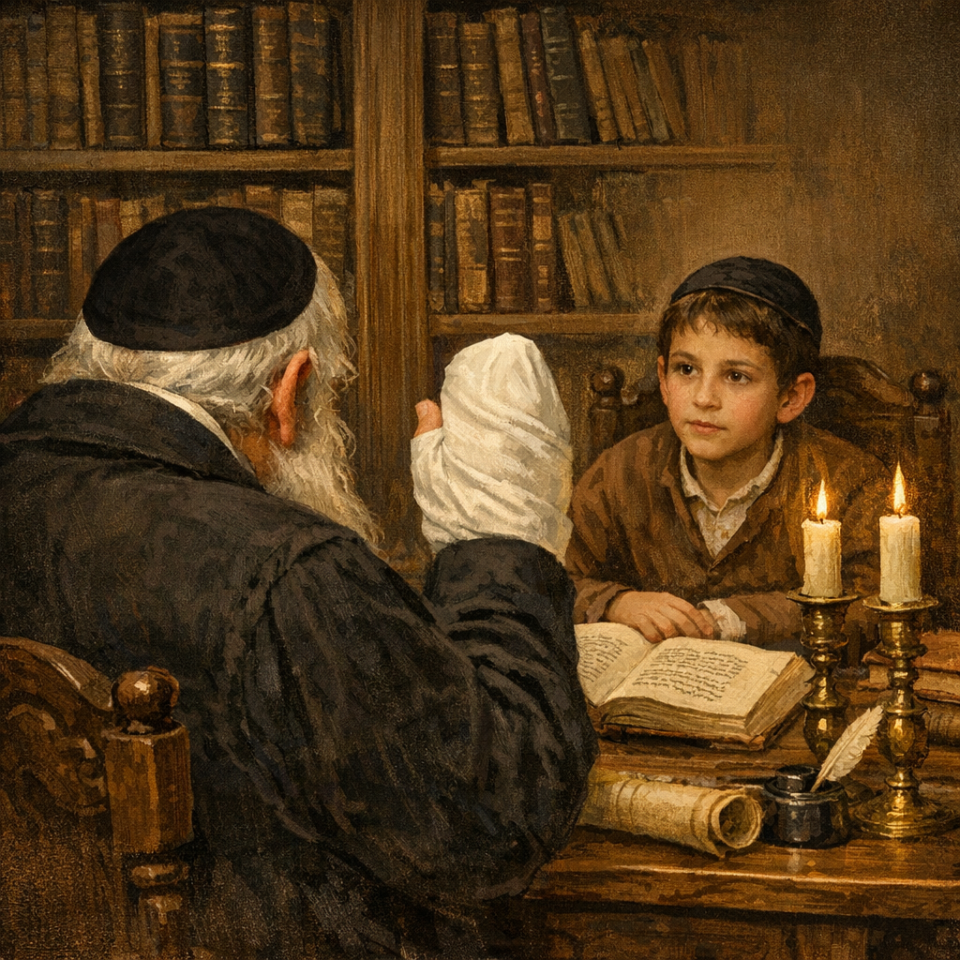
The chasid Rabbi Avraham Ber, son of Yirmiyah of Homel, was by nature a seeker and investigator. By the age of ten, he was already well-versed in the philosophical works of inquiry. His father, the chasid Rabbi Yirmiyah, feared that his son's probing, analytical nature might lead him, God forbid, to doubts in matters of faith. And so he brought the boy before the holy Tzemach Tzedek to receive his blessing for all good — and that his investigations would not lead him astray, God forbid.
The Tzemach Tzedek took his handkerchief and wound it around his holy hand, layer by layer, until the hand was entirely concealed from view. He then waved the handkerchief from side to side.
"What do you see?" the Tzemach Tzedek asked the child.
"The handkerchief moving from side to side," the boy replied.
"And what is moving the handkerchief?" asked the Rebbe.
"The Rebbe's hand," answered the child.
The Tzemach Tzedek pressed further: "But you cannot see the hand!" — and immediately continued: "Yet it is perfectly simple and clear to you that even what cannot be seen with eyes of flesh is nonetheless true and real…"
The young boy absorbed the message, and from that moment, his doubts fell away. He learned and ascended in Torah, in Chasidut, and in the fear of Heaven, until he became one of the great chasidim.
The Right Hand of Faith
The Tzemach Tzedek possessed the rare capacity to render tangible that which lies beyond the grasp of human intellect, to make faith palpable, visible, almost touchable. This is the hallmark of a true rebbe: a tzaddik who reveals Godliness to all those connected to him. The Tzemach Tzedek accomplishes this in the distinctly Chabad manner, through what we might call “rectified philosophy.” On the one hand, there is rigorous logical inference. On the other its very purpose is to illuminate a principle of faith that transcends reason and knowledge altogether. The intellect does not replace faith here—it serves as its vessel, its garment.
Two Menachem Mendels
The Tzemach Tzedek bore the name of another luminous figure: Rebbe Menachem Mendel of Vitebsk, eponymously known as Pri HaAretz. The Vitebsker too was gifted with an extraordinary sensitivity for making Godliness felt and present. Yet his way of doing so was more encompassing, more transcendent, less mediated through the structured pathways of the intellect. The Tzemach Tzedek always took care to clothe Godliness in intellect. He does so in this story and also by means of the teachings of his illustrious grandfather, the Alter Rebbe.
The fact that the Tzemach Tzedek chose his right hand, the hand that represents the sefirah of loving-kindness and the experience of love, is not incidental. It reveals the hidden motivating force behind the entire gesture, behind the entire Chabad project of clothing faith in intellect. It is not a cold philosophical exercise. It is an act of profound love for every Jew, and the will to bring faith to every person, even if that faith is currently concealed from the eyes of his intellect.

